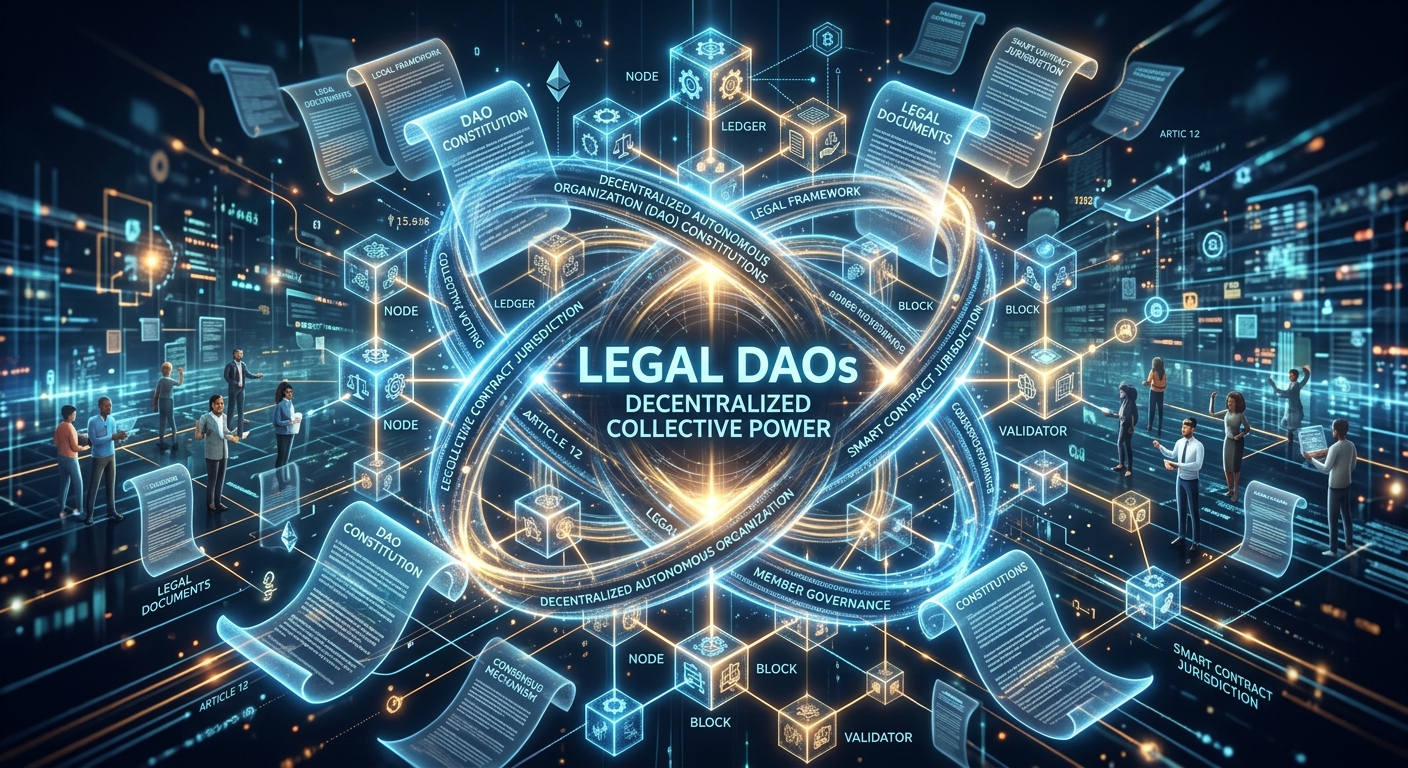
Something shifted quietly in April 2026, beneath the noise of protest marches and algorithmic news cycles. In Alabama — not exactly the first state you would expect — the governor signed the Decentralized Unincorporated Nonprofit Association Act into law, granting formal legal status to Decentralized Autonomous Organizations. Alabama became only the second U.S. state, after Wyoming, to recognize DAOs as legitimate legal entities: able to own property, enter contracts, and shield their members from personal liability. Effective October 1, 2026, on-chain governance has a seat at the legal table.
This might sound like dry legislative machinery. It is anything but. For decades, the architecture of collective action has been constrained by legal forms designed for corporations or nonprofits — structures that demand hierarchy, registered agents, and centralized control. The DUNA Act cracks that mold. It says, for the first time in binding law: a network of people, organized by smart contracts and consensus mechanisms, without a CEO or a headquarters, is a real thing. It exists. It has rights.
From Cypherpunk Dream to Legal Reality
The lineage here runs long. In the 1990s, cypherpunks argued that cryptography was a political tool — that code could enforce privacy, autonomy, and horizontal coordination more reliably than any government promise. Bitcoin, born from that tradition, proved that a decentralized network could maintain consensus without trusting any single actor. What followed — Ethereum, DAOs, on-chain governance — was an attempt to extend that logic from money to organization itself: What if a labor union, a mutual aid fund, a climate collective, could be governed entirely through transparent, tamper-proof code?
For years, the answer was: yes, technically — but legally, you were in a gray zone. Members of unregistered DAOs faced potential personal liability. Funds were hard to manage. Contracts were unenforceable. The law simply did not see you. Alabama’s DUNA Act, modeled on Wyoming’s earlier framework, changes that calculus. And the implications for grassroots organizing are significant.
What This Means for the Movements
Imagine a tenant mutual aid network — hundreds of members across a city, contributing to a shared emergency fund through micro-transactions, governed by community vote. Today that organization risks existing in legal limbo. Under a DUNA framework, it could hold a lease, negotiate collectively, sue a landlord, and protect individual members from liability — all without a board of directors, a nonprofit attorney, or a registered agent beholden to donor whims.
Or consider a climate direct-action collective: rotating leadership, no fixed hierarchy, decisions made by consensus. These organizations often struggle to open bank accounts, much less own infrastructure. A legally recognized DAO changes that. It allows decentralized collectives to interface with the material world — property, contracts, litigation — while preserving their horizontal character.
This is not utopia. Legal recognition comes with registration requirements, governance documentation, membership thresholds. The law shapes what it touches. There are genuine tensions between radical autonomy and institutional legibility. A DAO that registers with the Alabama Secretary of State is no longer entirely outside the system. That trade-off is real, and movements will have to navigate it consciously.
The Infrastructure of Collective Futures
What the DUNA Act represents — at its best — is the beginning of a legal commons. A space where decentralized collectives can accumulate resources, protect members, and exercise power without collapsing into the hierarchical forms that have historically captured and neutralized movements. It is infrastructure. And infrastructure, as any organizer knows, is not neutral — it shapes what becomes possible.
Across the world, movements are asking the same question from different angles. Taiwan’s Bluebird Movement demonstrated that a radically decentralized network of over 30 recall groups, operating without central command, could mobilize hundreds of thousands of signatures and reshape civic discourse. The “No Kings” demonstrations in U.S. cities opened public forums about distributed power that no single organization could have convened. Side With Love’s April 2026 report frames community resilience not as a program but as a practice — relationships built across differences, covenants renewed every day.
The thread connecting all of it: people are learning, again, that power does not have to flow from the top. That governance can be a practice rather than a position. That the commons — the shared resources, the mutual obligations, the collective intelligence of a community — can be encoded not just in tradition but in law, in code, in architecture.
Build the Commons. Defend It. Extend It.
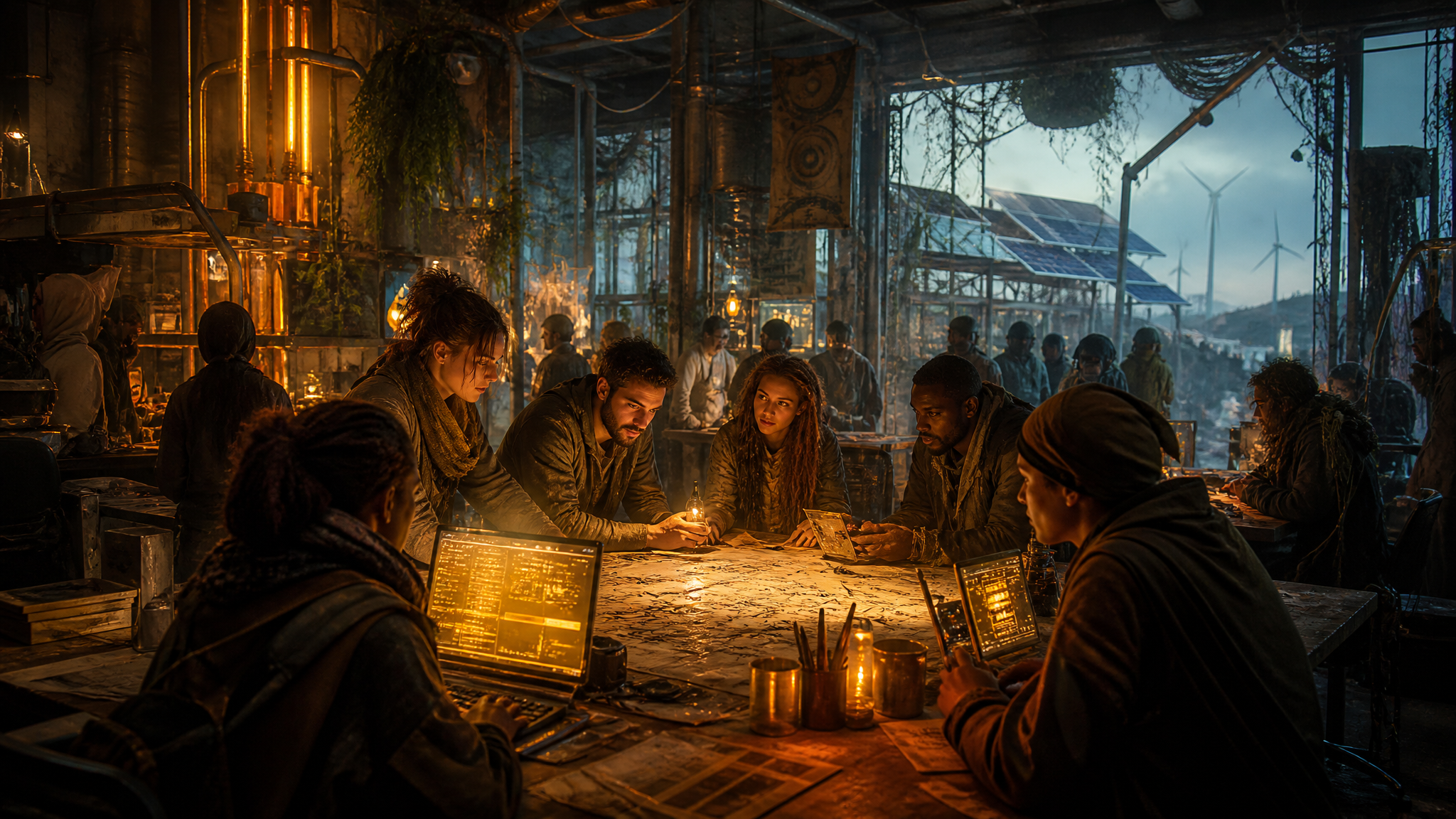
The solarpunk vision has always been partly technical and partly relational: solar panels on every roof, yes, but also neighborhood councils, repair cafes, seed libraries, open-source tools shared freely across communities. The DAO, at its radical potential, fits that vision — not as a cryptocurrency speculation vehicle, but as organizational infrastructure for the commons. A way for communities to pool resources, make decisions transparently, and hold power collectively without surrendering to the logic of the corporation or the state.
Alabama is not the revolution. But every time the legal architecture expands to accommodate horizontal power, something shifts. The commons inch forward. The question for movements is not whether to engage these tools, but how — with clear eyes about their limits, and clear intention about the futures they are building.
The grid is decentralizing. The law is slowly following. The people, as always, are already ahead.