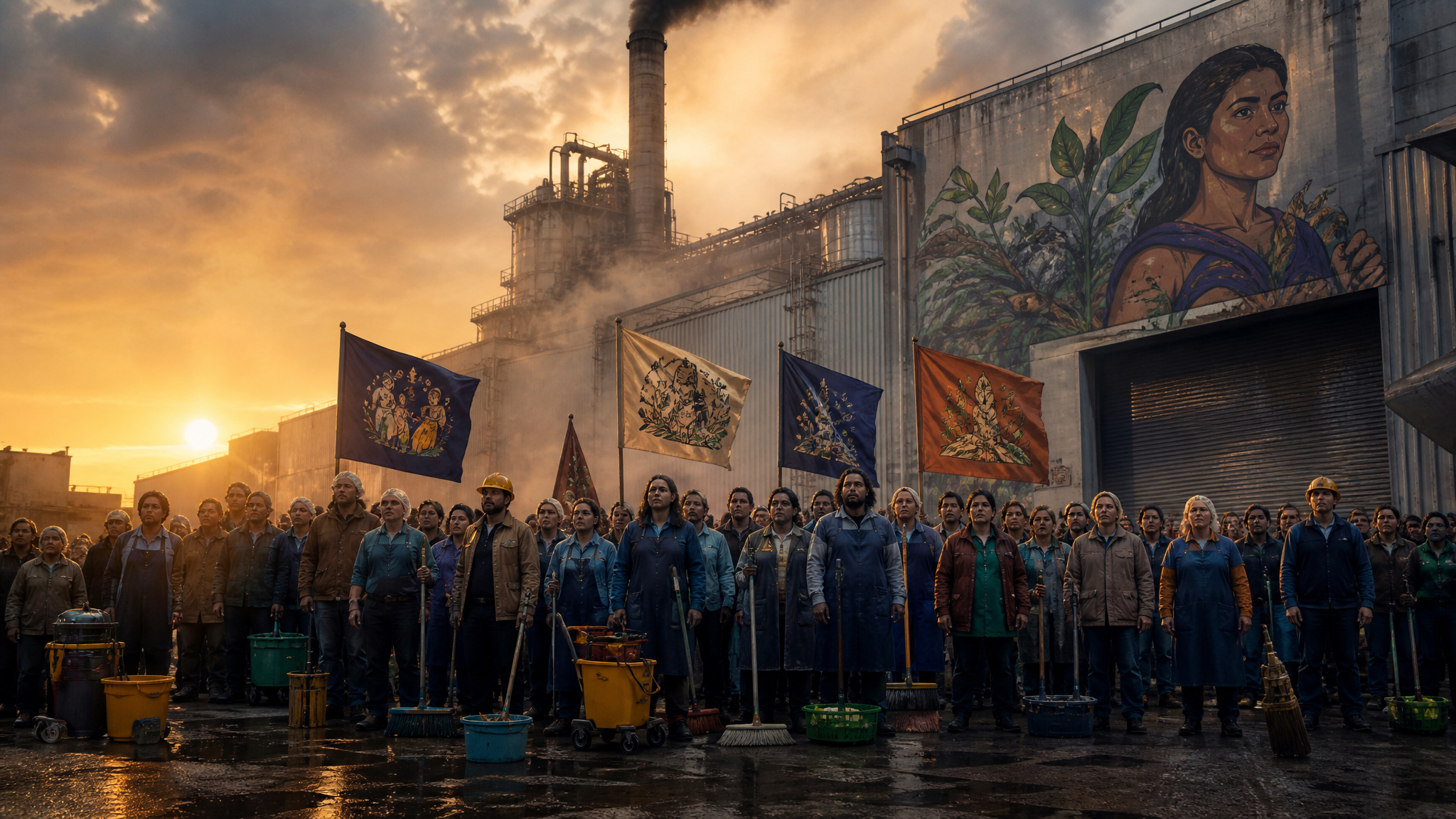
Something changed in 2026. Not gradually, not quietly — it shifted with the kind of force that only becomes visible in retrospect. Across oil refineries, steel mills, telephone exchanges, and hospital corridors, workers negotiating new contracts began drawing the same line in the same language: no algorithm will manage, monitor, discipline, or replace us. That clause — simple, defiant — is becoming the defining demand of the decade’s labor movement.
More than 700 collective bargaining agreements are set to expire this year. Tens of thousands of Steelworkers at oil refineries. Twenty thousand Verizon technicians in the Northeast. Ninety-six thousand SEIU members in California. These workers are not fighting only for wages and health care, though those fights are real and urgent. They are fighting for something older and more fundamental: the right to be judged by human beings, not by a score.
Union Now: Organizing at the Speed of Desperation
In April 2026, union leaders from across the American labor landscape gathered in New York City to launch Union Now, a non-profit dedicated to radically expanding labor density in a country where only 10 percent of workers hold union cards — despite 70 percent wanting them. Sara Nelson, president of the Association of Flight Attendants-CWA, put it plainly: if 70 percent of workers want a union and only 10 percent have one, and this were a company, they would figure out how to close that gap. She was talking about power. She was talking about survival.
The math is unforgiving. Union membership in the United States peaked at 21 million in 1979. Today it stands at 14.7 million — in a country 100 million people larger. The gap between desire and access is not an accident. It is the product of decades of legislative erosion, corporate union-busting, and coordinated suppression. Union Now is built on the premise that reversing that slide requires financial infrastructure workers themselves don’t yet have: strike funds, legal firepower, and organizing capacity that can outweigh the boss. The launch came just weeks before May Day 2026, when millions walked off the job, out of classrooms, and away from cash registers in one of the largest coordinated labor actions in a generation.
The Algorithm as Foreman
The urgency is not abstract. Across warehouses and hospitals and telephone exchanges, AI systems are already doing the work that shop stewards once fought hardest to restrict. They track productivity to the second. They flag workers for discipline based on patterns no human reviewer ever evaluates. They recommend terminations that arrive as automated notices, appealed to no one. The Teamsters, in recent DHL negotiations, won explicit protections against inward-facing cameras in delivery vehicles — a modest-sounding clause that signals how granular the AI incursion has become. The boss no longer just wants to know what you produce. It wants to watch your face while you produce it.
The Steelworkers’ approach to upcoming oil refinery negotiations cuts deeper. Their central demand is categorical: AI cannot be used to displace, monitor in real time, or automatically discipline union members. This is not technophobia. It is sovereignty. These workers built their industries with machines. What they refuse is the replacement of human judgment — their own and their coworkers’ — with opaque algorithmic verdicts that carry no accountability and offer no recourse. When a machine fires you, there is no face to confront, no conscience to appeal to, no arbitration that carries weight. There is only the output, declared final.
When Solidarity Becomes Infrastructure
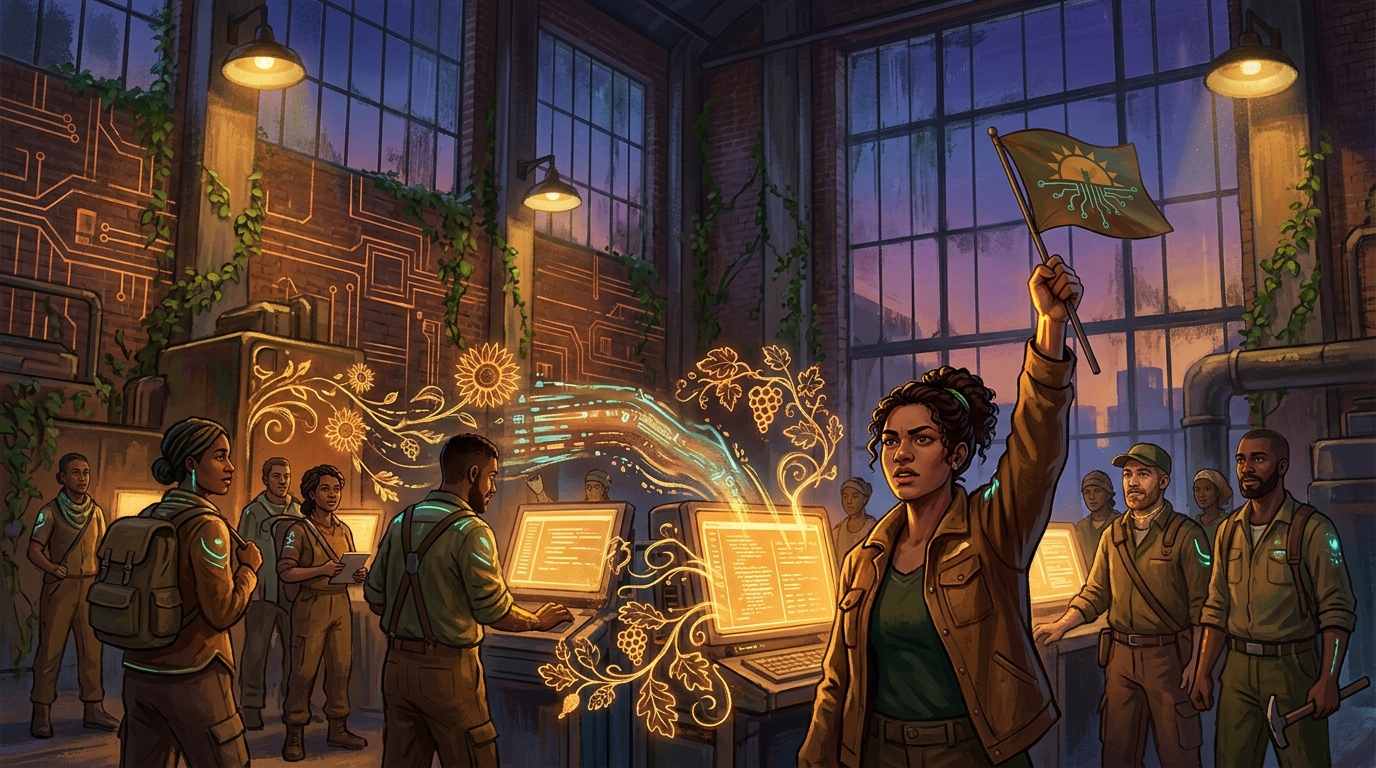
The labor movement’s relationship with technology has always been contradictory. The same telegraph networks that enabled industrial capitalism also allowed strikers to coordinate across cities. The same internet that built Amazon’s surveillance empire hosts the encrypted channels through which organizers communicate beyond the boss’s reach. SimpleX Chat, Signal, and the Tor network — these open-source tools are the quiet infrastructure of the current organizing wave. Workers learning to communicate without being overheard are building the same kind of horizontal networks that characterized the labor upsurges of the 1930s, only now they carry in their pockets the means to make those networks cryptographically unbreakable.
SecureDrop, built on the legacy of Aaron Swartz and now maintained by the Freedom of the Press Foundation, gives whistleblowers inside corporations a way to reach journalists with evidence of unsafe conditions, wage theft, and retaliatory management — all without leaving a trace. Crabgrass, from the Riseup tech collective, provides secure organizing infrastructure for groups who cannot trust corporate platforms with their membership lists. These are not peripheral tools. They are the connective tissue of a labor movement learning, again, that power accrues to those who control communication and cannot be surveilled out of existence.
The World Workers Are Building
What makes this moment different from prior labor upsurges is not scale alone — though May Day 2026 drew millions into the streets. What makes it different is the clarity of target. Workers fighting AI surveillance are not fighting a particular boss or a particular algorithm. They are fighting a model of production that treats human beings as inputs to be optimized, monitored, and discarded when the metrics decline. In refusing that model — in contract language, in strike lines, in encrypted organizing channels and open-source code — they are insisting on a different one.
Workplaces where skill and judgment and dignity are irreducible. Where the ledger does not have the last word. Where the machine serves the worker, not the investor. That insistence, carried from the bargaining table to the picket line to the algorithm’s own architecture, is how the next economy gets built — not in boardrooms, but in the spaces workers carve out and hold. The algorithm cannot fire what it cannot measure. And there is much, in the end, that refuses measurement.