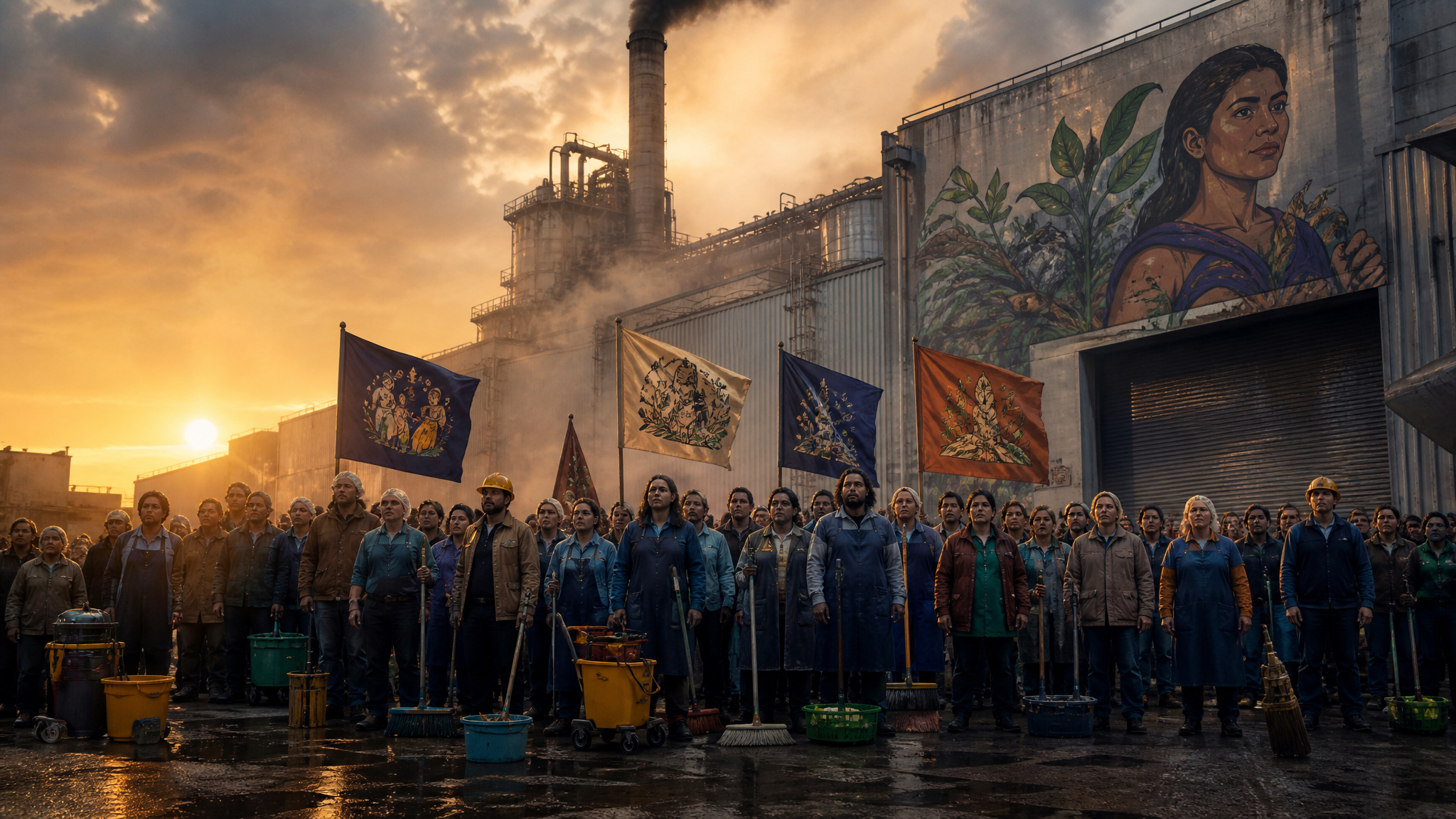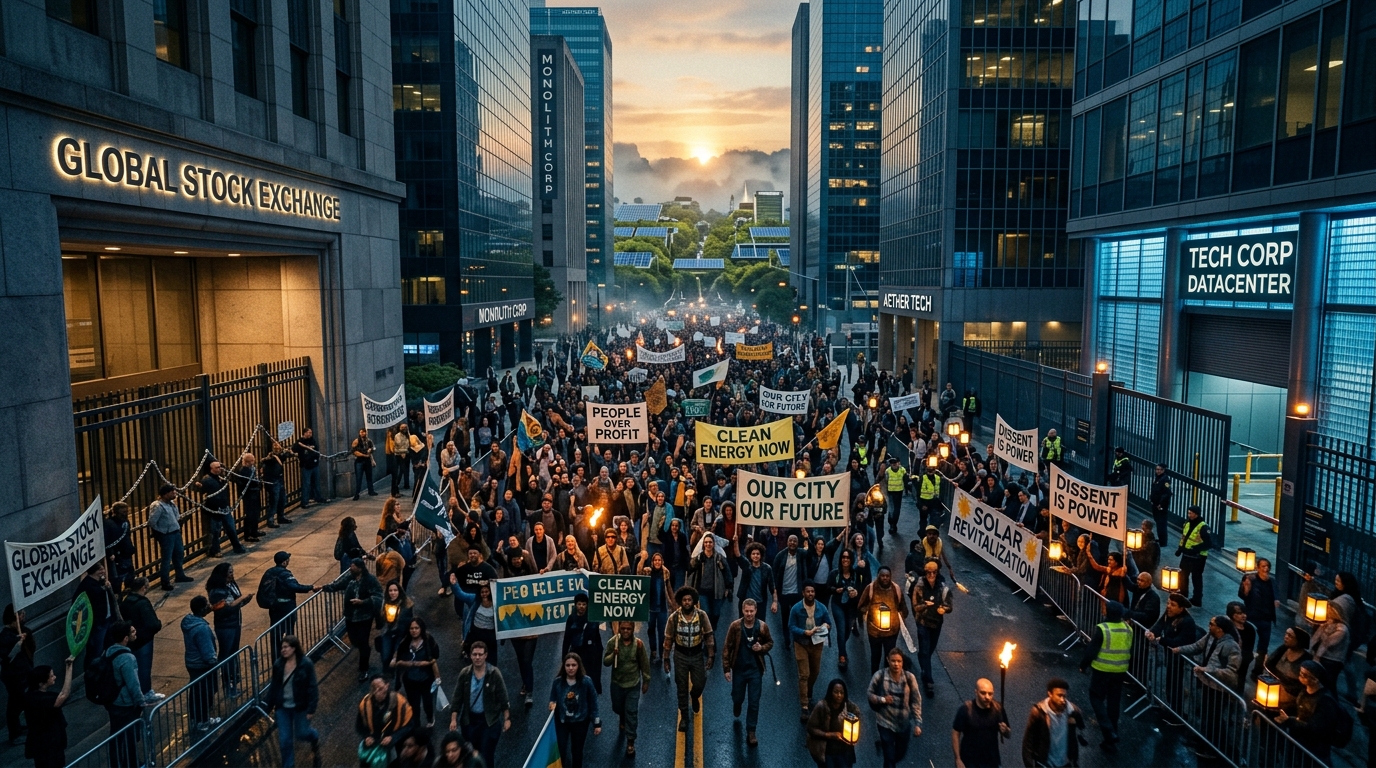
Something shifted on May 1st, 2026. It was not merely the size of the crowds — though they were immense, stretching across more than 3,500 cities and towns from Portland to Memphis, from Chicago to the Washington Mall. What shifted was the doctrine. The grammar of resistance, forged over more than a century of marches and rallies, was being rewritten in real time. This was not a protest. This was an economic strike.
The Body as Blockade
When Sunrise Movement activists chained themselves to the gates of the New York Stock Exchange on May Day morning, they were not staging a symbolic gesture for the cameras. They were choosing a target with precision: the financial nervous system of a system they refuse to sustain. When six protesters in Minneapolis were arrested for blocking a bridge during rush hour, they were not being disruptive by accident. When demonstrators in Memphis lay down in front of the entrance to Elon Musk’s xAI datacenter, they were not protesting at random. Every action pointed toward the same understanding: the machine runs on economic throughput, and the body, placed deliberately in its path, becomes leverage.
The May Day Strong coalition — more than a thousand national and local unions, labor councils, immigrant rights organizations, and community groups — called for something deceptively simple: no work, no school, no shopping. Three refusals. Three withdrawals from the economic flows that power the structures being contested. The slogan did not emerge from a think tank. It was born in Minneapolis, where community members developed the model in direct response to ICE raids tearing their neighborhoods apart. It spread because it worked — because it was legible, replicable, and required no central command to execute.
The Infrastructure of Refusal
What makes the economic blackout model genuinely new is its architecture. Previous mass actions required coordination at scale: a union hall, a charismatic leader, a permit, a sound system. The “no work, no school, no shopping” model distributes the cost of action so broadly that the barrier to participation nearly disappears. A worker who cannot risk arrest can still refuse to shop. A student in a conservative district can still stay home. A small business owner who sympathizes can still close for the day. The action draws its power not from a single spectacular confrontation but from the aggregate withdrawal of economic cooperation across millions of individual decisions.
This is not a boycott in the old sense. Boycotts target specific companies, demanding policy changes through market pressure. The economic blackout targets something larger: the normalcy of compliant participation in a system increasingly serving the interests of a narrow financial elite. It is, in the language of the theorists who study such things, a withdrawal of legitimacy — the quiet, distributed act of millions of people refusing to pretend that everything is fine.
Targeting the Sinews of Power
The most tactically significant moments of May Day 2026 were not the largest marches. They were the precise interventions at economic choke points. Amazon workers marching on corporate offices, demanding the company sever its contracts with ICE and DHS — directly connecting corporate infrastructure to surveillance and deportation. Healthcare workers with the Service Employees International Union confronting an Amazon warehouse in Chicago. San Francisco city officials arrested at the international airport alongside picketing airport workers resisting ICE presence in transit hubs. Each action identified a specific node where economic activity intersects with political power, and applied direct pressure there.
This is the logic of what organizers are beginning to call “targeted non-cooperation”: not a general strike in the traditional sense, but a series of coordinated refusals aimed at the connective tissue between capital and coercion. The tech oligarch who funds surveillance infrastructure. The retailer whose logistics network depends on precarious immigrant labor. The financial exchange that prices the bonds of a carceral state. These are not abstract symbols. They are specific pressure points, and the movement is learning to find them.
Beyond the Saturday March
Jackson Potter, vice president of the Chicago Teachers Union and one of the May Day Strong organizers, put it plainly in the weeks before the action: “If we aren’t figuring out ways to shut shit down, they’re going to outmaneuver us.” The statement is important not because of its urgency, though that urgency is real, but because of what it implies about the limits of the existing protest repertoire. The Saturday march, the rally at the park, the permitted demonstration that ends when the sound permit expires — these are not useless, but they are insufficient. They create visibility. They do not create friction.
Friction is what economic non-cooperation creates. The xAI datacenter in Memphis, briefly blocked by protesters’ bodies, experienced a small taste of the disruption its systems routinely impose on surveilled communities. The NYSE, momentarily choked by chained activists and surrounded by chanting workers, experienced a flicker of the precarity its algorithms inflict daily. The friction is not yet enough to break the machine. But the doctrine that produces it — decentralized, economically targeted, and grounded in the logic of withdrawal rather than petition — is maturing into something the architects of concentrated power have real reason to fear.
The Long Game
What is being built is not a single movement but a new infrastructure of refusal: distributed, resilient, and capable of applying pressure at precisely the moments and locations where it is most costly to absorb. The lessons of Minneapolis — where a community under direct attack developed economic non-cooperation as a survival mechanism — are now traveling outward, being adapted, tested, and refined in dozens of contexts simultaneously. No leader can be arrested to stop it. No organization can be defunded to dissolve it. It lives in the distributed intelligence of people who have decided they will no longer pretend that compliance is neutral.
The machine, after all, only runs because we keep showing up to operate it. The economic blackout asks a simple question: what happens when we stop?