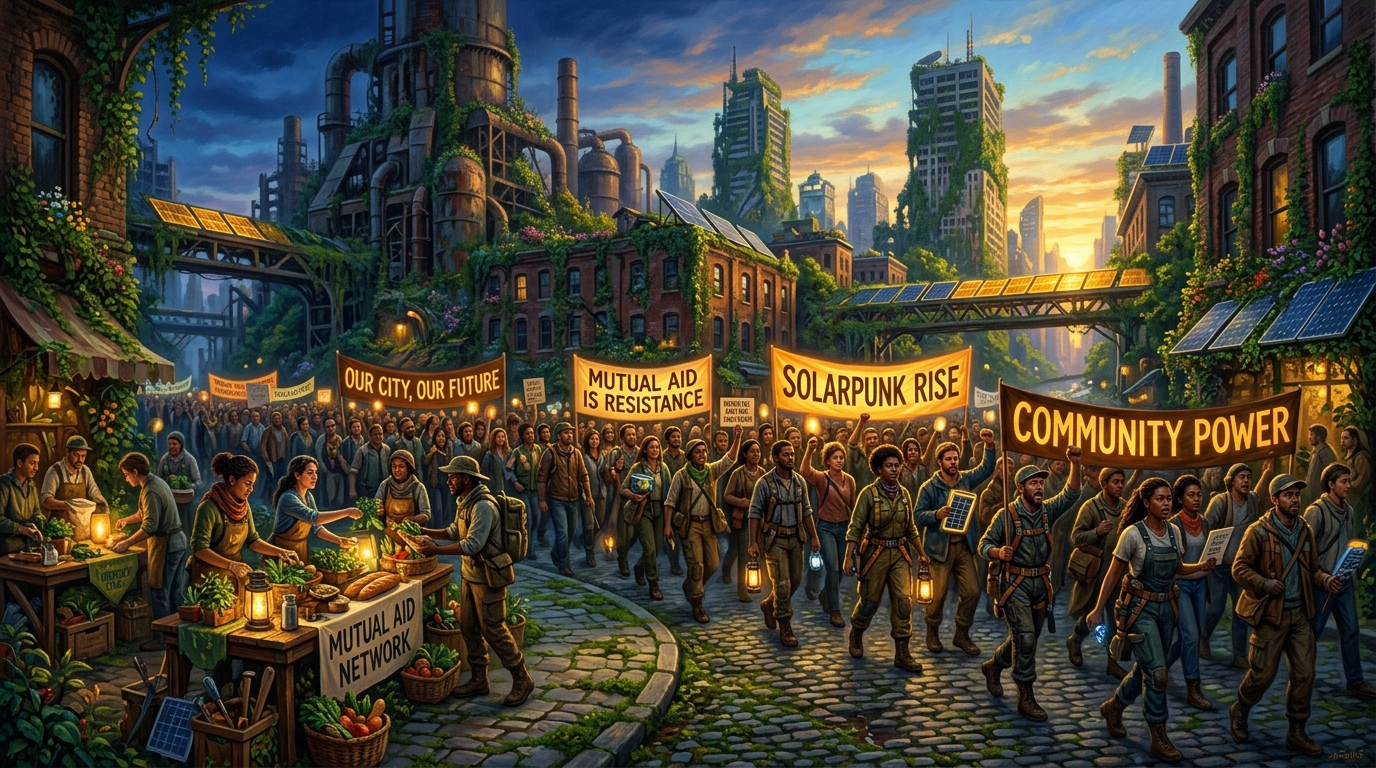
Something is shifting in the architecture of resistance. For decades, labor unions and democracy movements operated on parallel tracks — one fighting for wages and workplace dignity, the other defending civil rights and institutional norms. In 2026, those tracks are merging, and May Day is the junction.
The Strike That Started in a Parking Lot
On January 23rd, the city of Minneapolis stopped. Tens of thousands of workers, immigrants, students, and neighbors — bound by no single union card, no central leadership, no official permit — declared an economic blackout in response to escalating ICE raids. Businesses shuttered voluntarily. Schools emptied. Transit drivers refused their routes. The action was not called by any organization that could be pressured into standing down. It spread through encrypted group chats, neighborhood networks, and word of mouth. It was, in the truest sense, leaderless.
That January day became the blueprint for what organizers are now calling May Day Strong — a national general strike on May 1st built on the same decentralized logic. More than 3,500 actions are planned across the country under a single shared banner: workers over billionaires, democracy over autocracy, community over empire. No single leader can be pressured. No single organization can be defunded. The movement is the infrastructure.
The Solidarity Stack: Digital Tools as Collective Weapon
What makes May Day Strong structurally different from labor actions of the past is not just its politics — it is its technology. Organizers are not relying on mass email blasts from a headquarters that can be hacked, surveilled, or litigated into silence. They are building what technologists at the 2026 Solidarity AI conference call a “solidarity stack”: interconnected, open-source, locally governed digital systems that no corporation or state actor can fully capture.
The Chicago Teachers Union secured May 1st as an official day of civic action in their city not through backroom deals but through sustained, distributed community pressure. The National Education Association published organizing toolkits as open documents, freely forkable, freely adapted. Mutual aid networks across the country shifted their communication to Signal months ago, following guidance from UC Berkeley’s Cybersecurity Clinic and Fight for the Future, whose jointly released guide — Securing Mutual Aid — laid out the architecture of a surveillance-resistant organizing network in plain language any neighborhood could act on.
Elsewhere, the OpenCourier protocol — a common technical foundation letting worker-owned delivery platforms federate without corporate intermediaries — is demonstrating that solidarity infrastructure can be built code block by code block, city by city. It is not glamorous work. It is the most important work happening right now.
The Convergence and What It Demands
Neidi Dominguez of the May Day Strong coalition put it plainly: the labor movement cannot advance while ignoring the assault on democracy, and the pro-democracy movement cannot ask working people to defend abstract principles while they cannot afford rent. This is not a tactical alliance of convenience. It is a recognition that economic exploitation and authoritarian governance are the same project, executed through different departments.
The movements that are winning — in Minneapolis, in Chicago, in the leaderless uprisings across the Global South that we have documented in these pages — share a structural trait: they distribute power so completely that no single point of failure can collapse them. They train organizers who train organizers. They use tools that cannot be subpoenaed into silence. They build mutual aid networks that make the state’s cruelty visible by providing what the state refuses to.
May Day 2026 is not a protest. It is a proof of concept — a demonstration, visible to everyone including those who fear it, that the architecture of collective power is being rebuilt from the ground up. The convergence of labor solidarity, digital autonomy, and community self-defense is not a moment. It is a method.
What You Can Do Before May 1st
If you are reading this in the two days before May Day, there is still time to plug in. Find a local action at mobilize.us. Download Signal and help your mutual aid network migrate. Share the NEA and May Day Strong organizing toolkits with anyone who needs them. Show up — and if you cannot show up, do not shop. Economic power is still power, distributed across millions of individual choices made on the same morning.
The sun does not ask permission to rise. Neither should we.