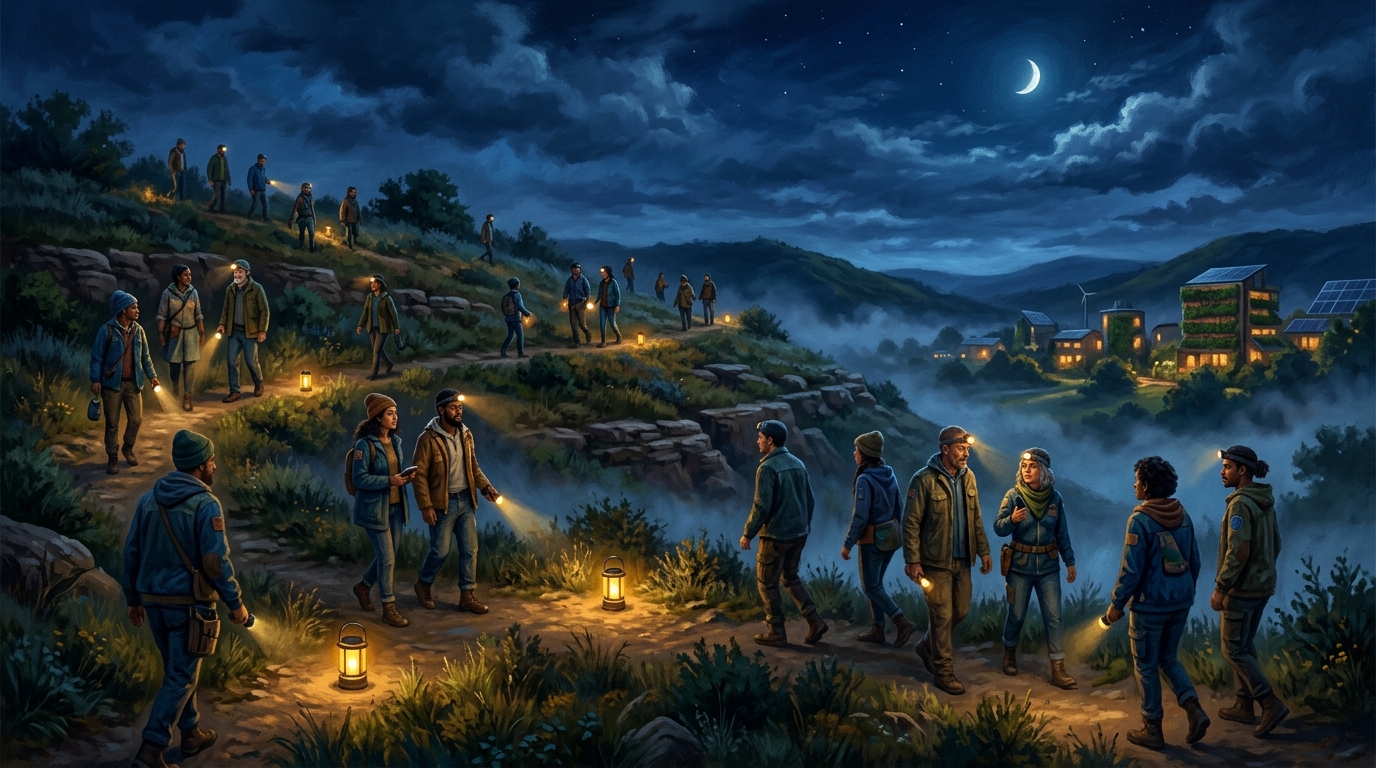
Somewhere in the occupied West Bank, on a mountain above the sleeping village of Sinjil, young men sit in a tent held down by stones against the wind. They watch the hills. Across the valley, a flashlight blinks — someone on the other side is watching too. This is not a military operation. There is no state sponsoring it, no NGO coordinating it, no app monetizing it. It is something older and more stubborn: people refusing to be unprotected.
The Architecture of Survival
The committees are called night guards, or protection committees — a loose network of volunteers who have taken on the work of defending Palestinian villages from escalating settler violence in the West Bank. Since 2025, settler attacks have reached what the UN describes as unprecedented levels, with over 260 Palestinians injured in the first months of 2026 alone — a threefold increase over the prior year’s monthly average. The official response has been weak. So communities built their own response: rotating watches, shared phone chargers for communication devices, signal systems using flashlight beams across the dark hills.
What R.M., a regular participant in Sinjil’s watch, calls the old model was “faz’a” — the organic Palestinian tradition of community members rushing collectively to each other’s aid. What they have now is more organized, more sustainable, more prepared. But it is still faz’a at its core. It is still the community protecting itself because it has no one else.
A Continent Away, the Same Logic
In Corona, Queens, a different kind of watch is happening. Volunteers in a rapid-response network monitor neighborhood streets, phones ready. When immigration enforcement agents are spotted, a call goes out. Dispatchers relay information. Community observers deploy to the scene to document, to bear witness, to provide know-your-rights information to anyone affected. Families separated by detention are connected to legal resources. Fundraising kicks in before the arrest paperwork is processed.
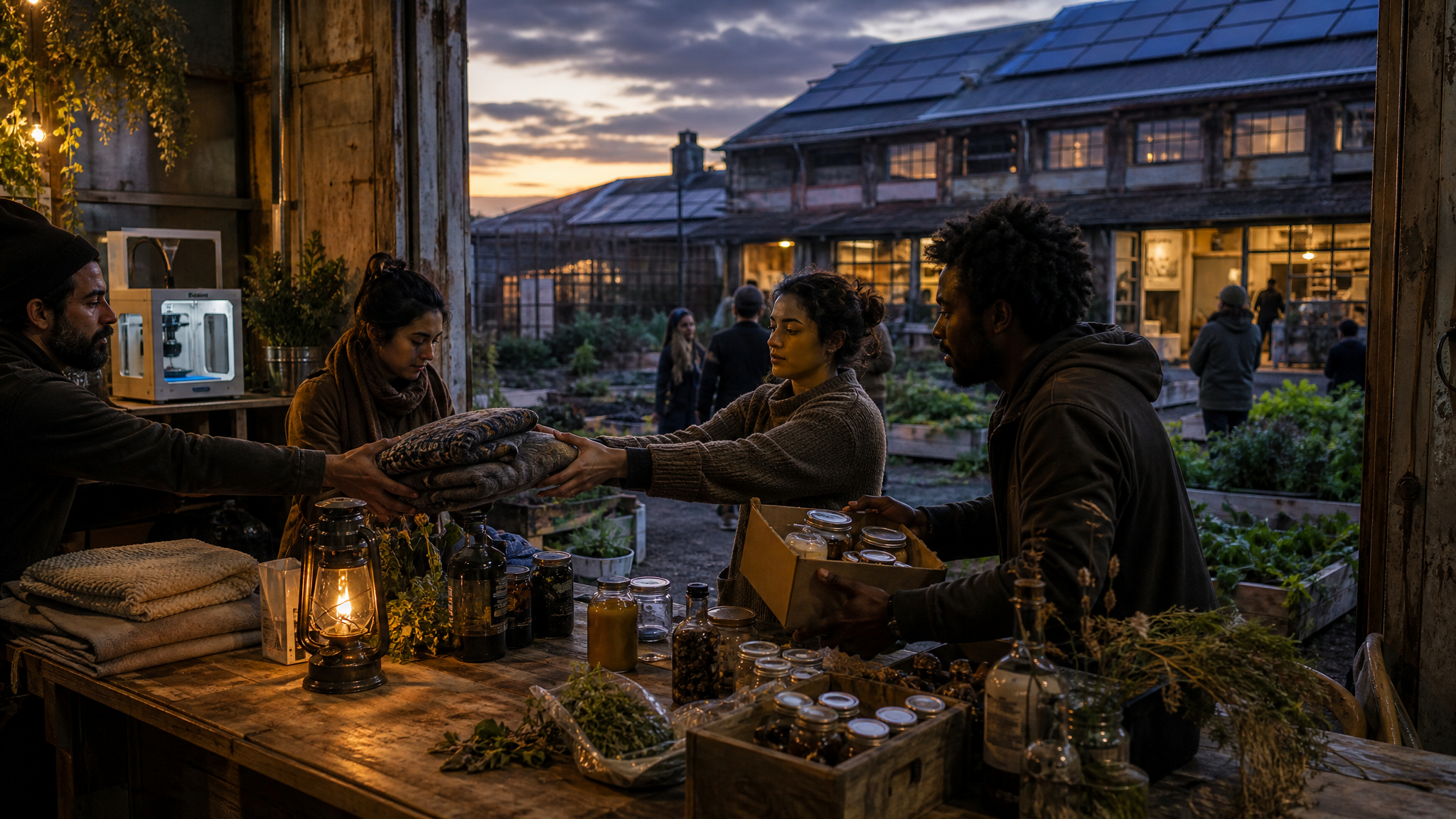
Across the United States in 2026, these immigration rapid-response networks have become some of the most sophisticated examples of decentralized community infrastructure in the country. Operating 24/7 hotlines, court-watch programs, multilingual legal education, and direct material support — food, rent, diapers, resettlement assistance — they have built systems that parallel what the state refuses to provide. In California, Minnesota, Arizona, Illinois, Texas, and dozens of other states, tens of thousands of ordinary people have organized themselves into something that functions, something that holds.
Mutual Aid Is Not Charity
There is a phrase that has become common in mutual aid circles: “Solidarity, not charity.” It sounds like a slogan but it points at something structural. Charity flows downward — from those who have toward those who lack — and it reinforces the hierarchy between them. Mutual aid moves horizontally. It is based on reciprocity, on the understanding that any of us could need the network on any given night, and that the network is only as strong as how many people build and maintain it.
The night guards of Sinjil and the rapid-response volunteers of Queens are not running charities. They are building infrastructure. Infrastructure that does not depend on the goodwill of a state that has already demonstrated its indifference or hostility. Infrastructure that belongs to the community because the community built it, sustains it, and governs it.
What Decentralized Protection Actually Looks Like
Encrypted messaging apps — Signal, WhatsApp, Telegram — are the nervous system of both kinds of networks. Not because they are glamorous tools, but because they allow information to flow fast and laterally, without a central node that can be shut down. In Queens, dispatchers coordinate in real time. On the hills of Sinjil, a flickering flashlight carries the same message: we are here, we are awake, we see you.
Both networks have also had to professionalize their informality. Moving from spontaneous community response to structured, sustainable operation requires training, documentation, and systems for accountability — without losing the participatory, non-hierarchical character that makes them effective. This is the tension at the heart of building power without building bureaucracy. Many movements have failed at it. These networks are still learning, which means they are still alive.
The Long Game
Mutual aid has always existed. What is new — or newly visible — is the scale, the sophistication, and the self-awareness with which communities are building these systems. The people watching the hills of the West Bank and the streets of Queens are not waiting for reform. They have understood, in the way that history eventually teaches everyone, that protection must be built where you live, by the people who live there.
That is not resignation. It is a deeper kind of hope — the kind that does not rely on someone else’s goodwill or attention span. The kind that knows the flashlight will blink back from the other hill because someone over there has also decided to stay awake. The architecture of survival is not built in capitals or boardrooms. It is built in watch tents held down by stones, in group chats that light up at 2 AM, in the stubborn refusal to be abandoned without answer.
When the state fails, the people watch. And when enough people watch, they become something the state did not plan for: a network that holds.