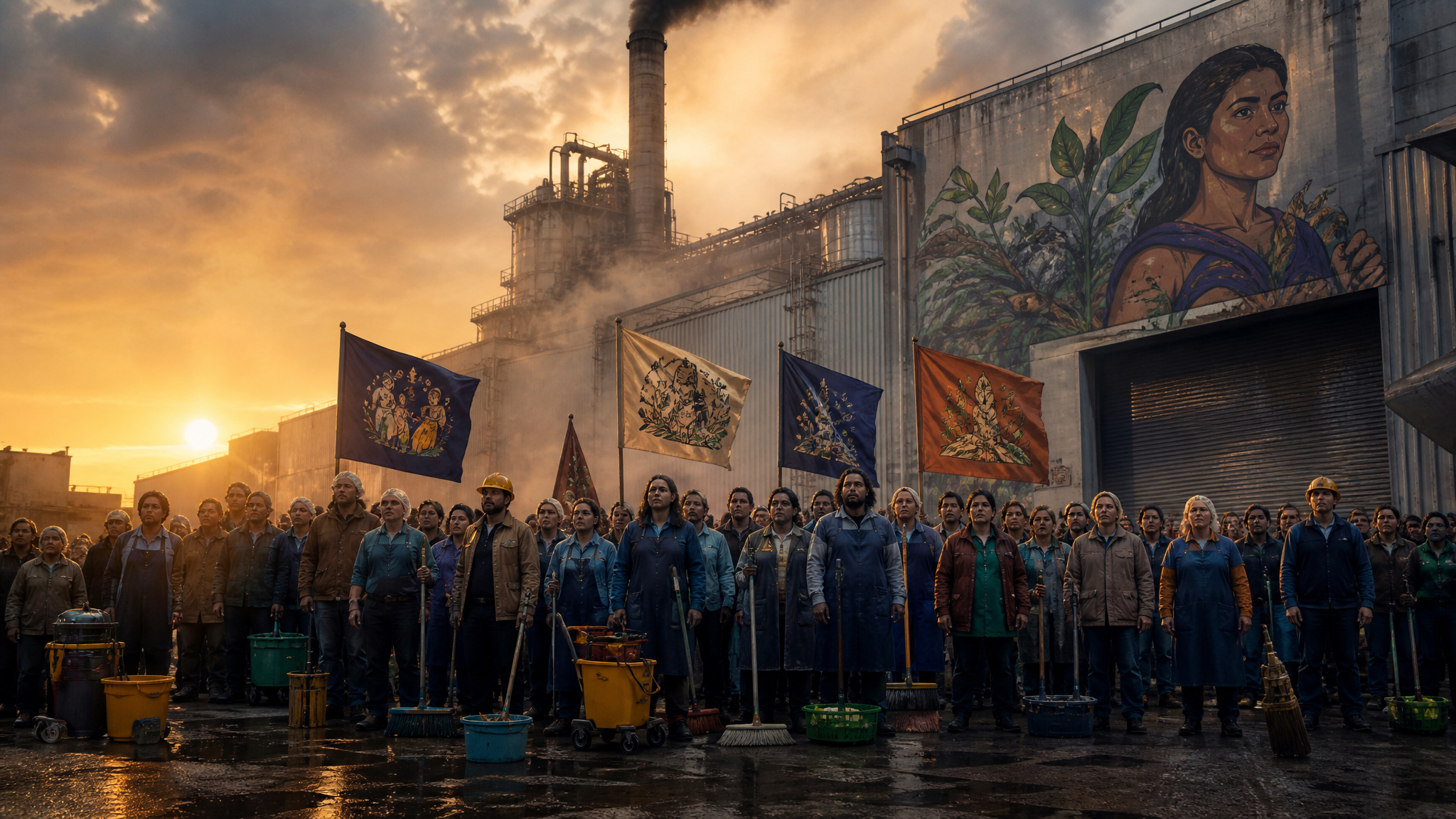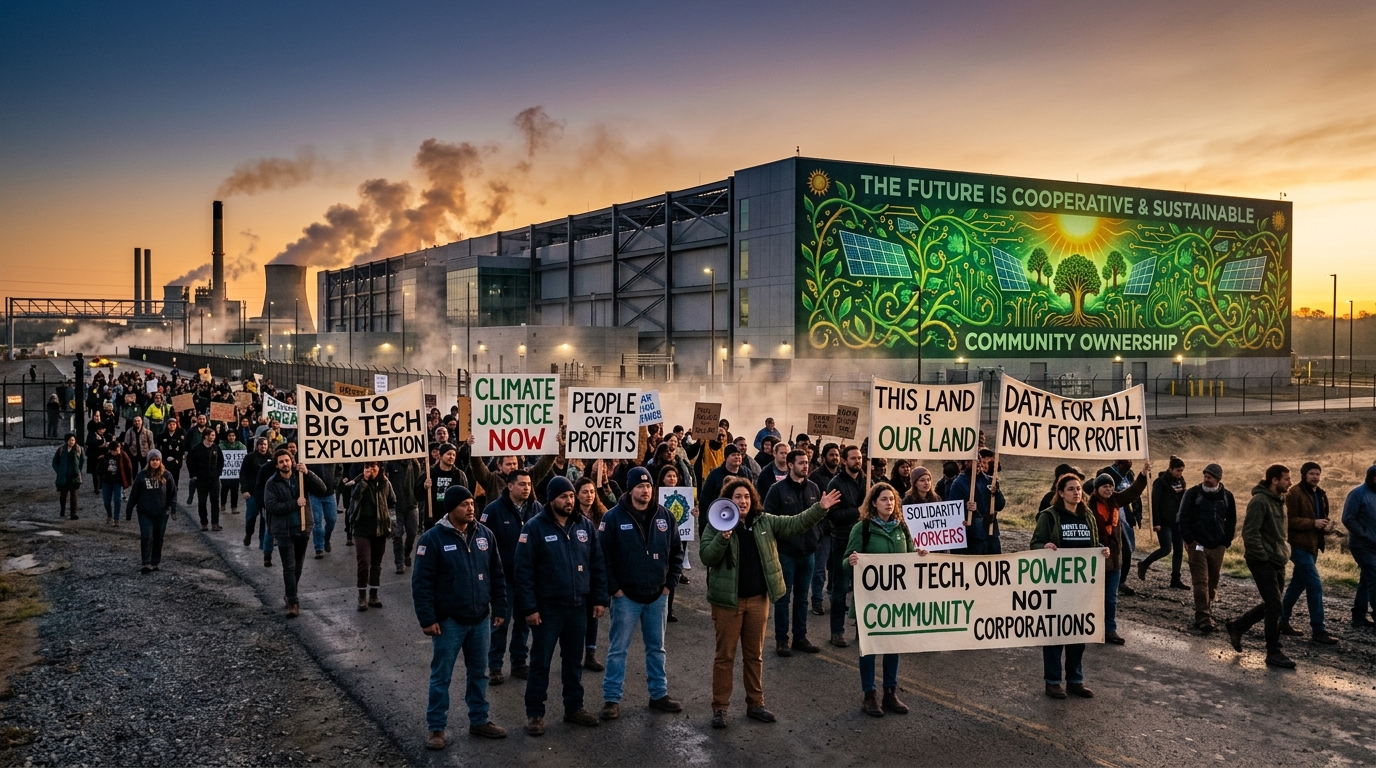
On the morning of May 1, 2026, a group of Amazon workers and Teamsters marched through Midtown Manhattan, past the steel-and-glass towers of corporate power, to stand outside Amazon’s corporate offices with a demand that cut to the core of what this May Day meant: stop helping the government hunt our neighbors. They weren’t just striking for wages. They were demanding that their employer sever its contracts with Immigration and Customs Enforcement and the Department of Homeland Security — contracts that route Amazon’s cloud infrastructure directly into the machinery of deportation and surveillance.
This is the new terrain of resistance. Not only the picket line, but the server room. Not only the wage, but the architecture of control that corporate giants have quietly built and leased to the state.
The Machine Inside the Machine
Amazon’s relationship with ICE is not incidental. Amazon Web Services provides cloud computing backbone to federal agencies conducting mass immigration enforcement — facial recognition tools, data warehousing, case management systems that track millions of people without their knowledge or consent. When workers at Amazon organize, they do so not just as employees demanding fair treatment, but as people who understand that their labor builds infrastructure that can be turned against their own communities.
The May Day march in New York was not the first time this confrontation has taken shape. In February 2026, Seattle protesters — many of them Amazon workers and contractors — surrounded the company’s headquarters demanding it cut ICE ties. The Teamsters, now deeply embedded in the fight to organize Amazon’s sprawling logistics empire, have made corporate complicity with surveillance apparatus a central rallying point. That convergence — labor rights and digital rights, worker solidarity and immigrant solidarity — marks a maturation in how resistance movements understand corporate power.
Memphis and the Colossus
Simultaneously, in Memphis, Tennessee, demonstrators blocked the entrance to xAI’s Colossus I data center in Southwest Memphis. The protest targeted not only the environmental toll of the facility — its gas-powered turbines burning fossil fuels to cool servers in a predominantly Black working-class neighborhood — but the broader question of whose communities bear the cost of building AI empire. Residents have organized for months against the noise, the air pollution, and the lack of community benefit. On May Day, they were joined by climate activists and labor organizers who understand that the geography of tech infrastructure is never accidental.
Data centers are not neutral buildings. They are nodes in networks of power — economic, political, and increasingly military. The communities that host them rarely profit from them. They absorb the heat, the pollution, the noise, and the danger while wealth is extracted and transmitted elsewhere. The Memphis action named that extraction clearly and planted a body in front of it.
Workers as the Firewall
There is a phrase gaining traction in labor organizing circles: workers as the firewall. The idea is simple and radical. When corporations become arms of state surveillance — when your employer’s cloud platform tracks immigrants, when your employer’s AI tools are licensed to police departments, when your employer’s logistics network is used to enforce federal detention orders — the workers inside those systems become the last line of accountability. They can refuse. They can organize. They can make it costly to comply.
This is not abstract. Amazon workers who handle government contracts exist. Engineers who build facial recognition tools exist. Drivers who have been asked to report community members to federal agents exist. Their decisions — individual and collective — matter enormously. The labor movement has historically understood itself as a moral force as well as an economic one. The question of what workers are willing to build, and for whom, is older than the tech industry.
The Convergence That Cannot Be Undone
What May Day 2026 demonstrated, in the streets of New York, Memphis, San Francisco, Portland, and hundreds of other cities, is that the separate tributaries of resistance are flowing together. Climate justice and labor rights. Immigrant solidarity and digital privacy. Anti-war sentiment and anti-monopoly organizing. These are not competing agendas. They are facets of the same understanding: that concentrated power — whether in a government agency, a tech giant, or a financial institution — operates as a unified system, and resistance to it must eventually become unified too.
The workers who marched to Amazon’s offices were not making a political statement in the narrow sense. They were demonstrating a principle that has always animated genuine labor solidarity: you do not build weapons to use against the people standing next to you. The cloud is not neutral. The data center is not neutral. The contract is not neutral. And neither are the workers who keep it all running — if they choose not to be.
That choice, made collectively and in public on the first day of May, is the most dangerous thing the resistance has to offer.