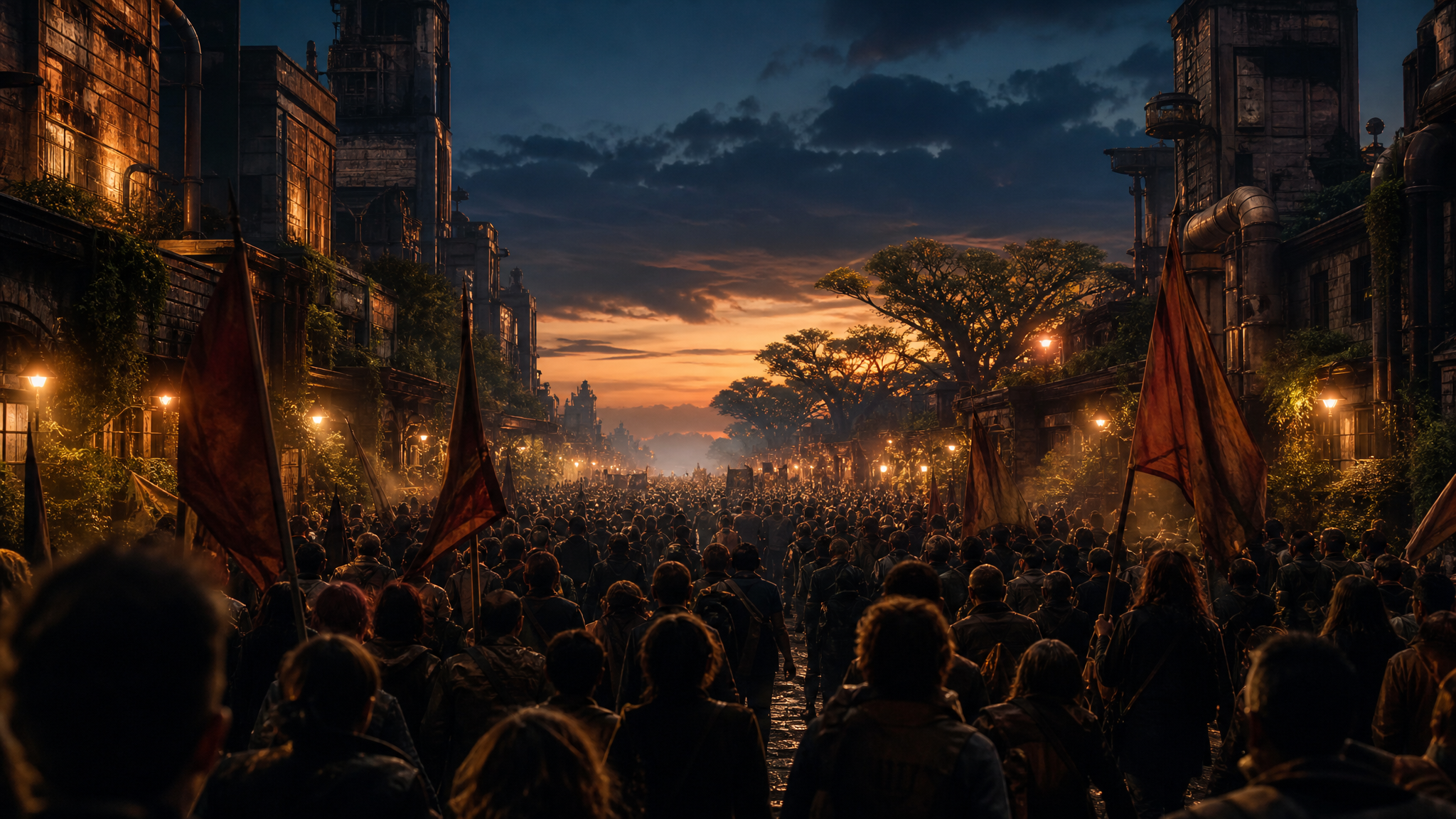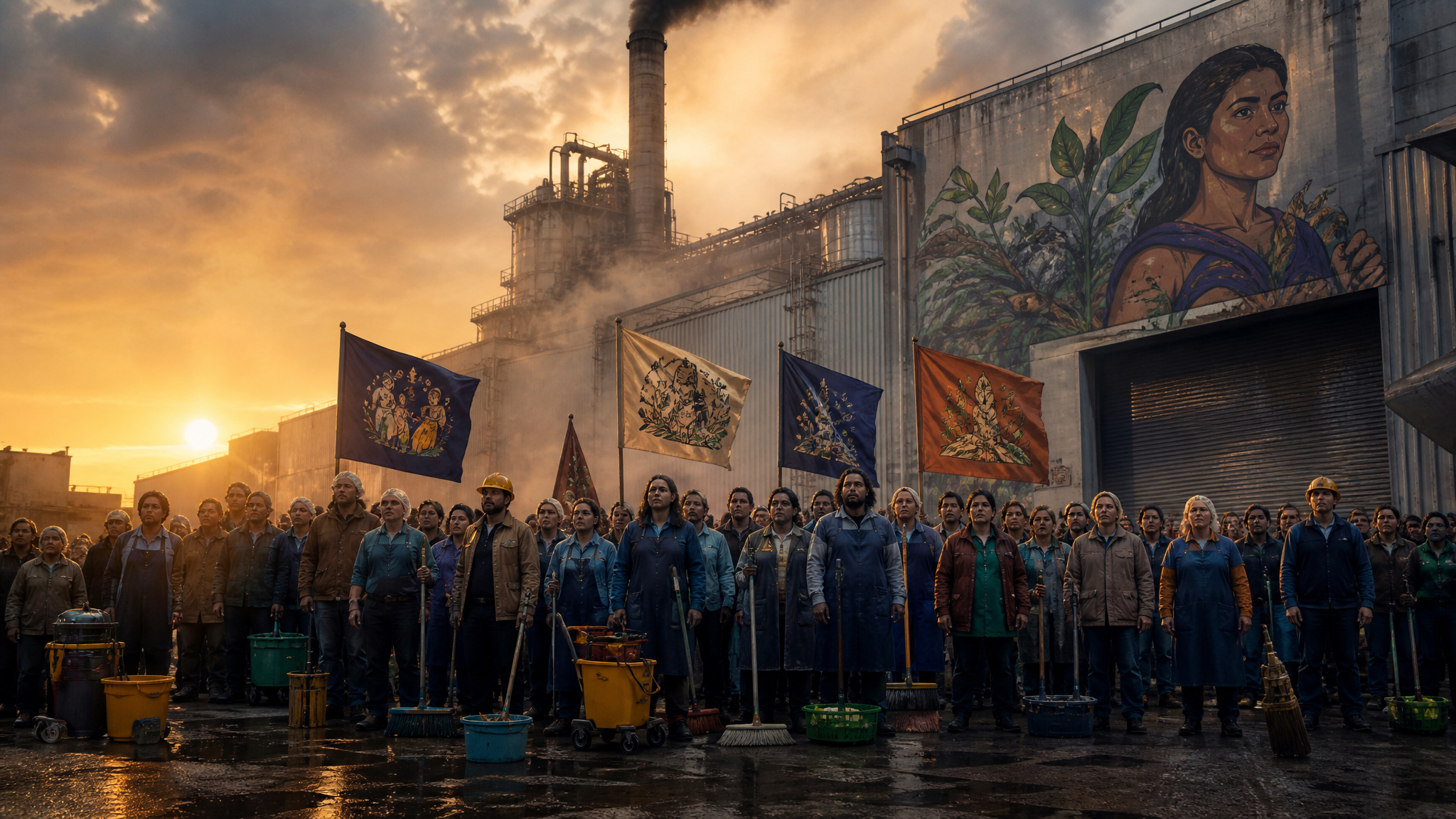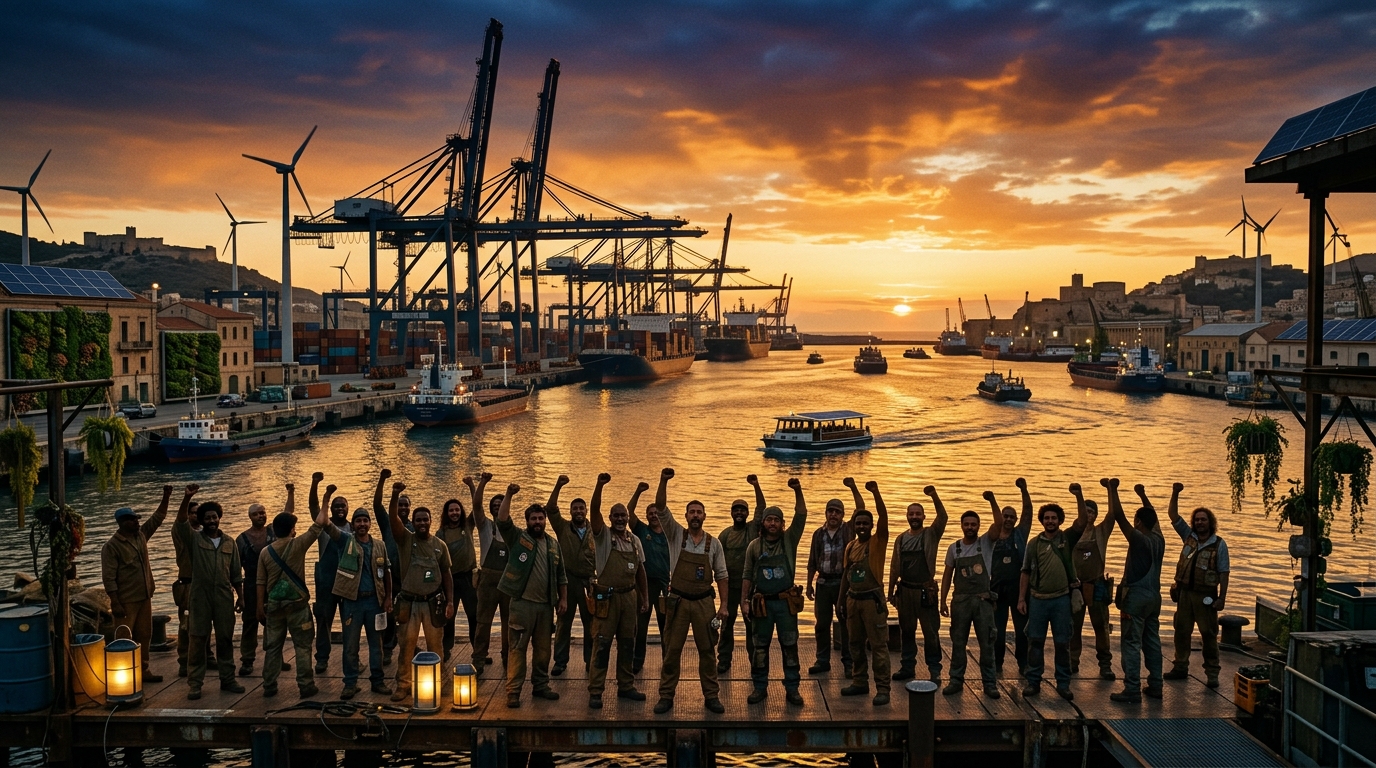
When twenty Mediterranean ports went dark in February 2026, it wasn’t a natural disaster or a cyberattack that stopped the ships. It was workers — dockworkers, crane operators, longshoremen — deciding collectively that their hands would not load another weapon bound for a war zone. Across Italy, Greece, Spain, and beyond, the message was unified and unambiguous: ports are places of work, not war.
What unfolded across more than twenty Mediterranean ports in February was more than a labor action. It was a demonstration of decentralized power at its most visceral — bodies, hands, and collective will inserted directly between the machinery of empire and its logistics chain.
Italy’s Ports Lead the Way
In Italy, the Unione Sindacale di Base (USB) coordinated nationwide strikes, bringing significant action to the ports of Genoa, Trieste, Livorno, Naples, and Palermo. Four cargo ships bound for Israel were reportedly blocked; vessels operated by Zim Integrated Shipping Services and MSC Mediterranean Shipping Company watched their itineraries collapse. These were not spontaneous outbursts — they were the result of sustained organizing, political clarity, and the kind of class consciousness that refuses to separate the job from its consequences in the world.
Italian dockworkers have been building this capacity for years. In 2025, workers in Genoa and Marseille refused to load weapons parts, forcing ships to depart without cargo. What happened in February 2026 was the maturation of that practice into something coordinated, multinational, and impossible to ignore.
Greece and Spain Join the Refusal
Greek dockworkers under the Enedep union and the All-Workers Militant Front (PAME) launched a 24-hour citywide strike in Piraeus, one of the Mediterranean’s busiest ports. Their slogan carried the weight of clarity that bureaucratic language always obscures: ports are places of work, not war. In Spain, solidarity actions rippled through ports in Bilbao, Pasaia, and Barcelona, building on prior actions where union pressure and Palestinian solidarity movements had forced the cancellation of steel shipments.
The World Federation of Trade Unions (WFTU) coordinated support across these actions, their demands explicit: a complete arms embargo, humanitarian aid corridors, and a rejection of the European Union’s rearmament agenda. These weren’t just labor grievances — they were a comprehensive vision of a world not organized around weapons and warfare.
The Crackdown Amnesty Won’t Let Us Forget
Into this context arrives Amnesty International’s annual report, released April 20, 2026, and its language is not gentle. The organization documents what it calls a “predatory, anti-rights order” — a coordinated global erosion of the right to protest, the right to assemble, the right to exist in public opposition to power. In 2025 alone, post-election protests in Tanzania resulted in hundreds of deaths; youth-led anti-corruption actions in Nepal saw 76 people killed by state violence.
What Amnesty describes is not a series of isolated tragedies. It is a pattern — the systematic weaponization of law, the militarization of police, the use of unlawful surveillance to map and dismantle civil society before it can cohere into power. Governments are not simply responding to protest; they are engineering a world in which protest becomes too costly to continue. The militarization of ports, the criminalization of solidarity, the designation of labor actions as security threats — all of it is part of the same architecture of control.
The Infrastructure of Refusal
And yet the dockworkers stopped the ships. That matters more than it might seem.
What the Mediterranean actions demonstrate is that the infrastructure of empire — ports, shipping lanes, logistics networks — is also the infrastructure of refusal. The same chokepoints that allow weapons to move are chokepoints where workers can intervene. The same physical reality that makes global trade possible also makes global solidarity legible as force.
This is not an abstract principle. It is a practical observation about where power actually lives. It does not live in declarations or policy papers. It lives in the decision of a crane operator in Genoa to leave the dock idle, in the collective refusal of a shift in Piraeus to lift a manifest. The predatory order Amnesty documents is real. So is the capacity of organized workers to interrupt it.
What the Dockworkers Teach Us
The Amnesty report urges governments to “protect the protest.” But the dockworkers of the Mediterranean offer a different lesson: sometimes the point is not to ask protection from power, but to demonstrate what power actually is when people organize around it.
The shrinking of civic space Amnesty tracks is a real threat. But every movement that has ever changed anything has operated under some form of hostile conditions. The history of labor is the history of organizing under systems designed to prevent organizing. The history of anti-war resistance is the history of acting against official consensus with nothing but solidarity and willingness to stop.
What the February 2026 port actions show is that direct action — physical, coordinated, built on relationships within workplaces and communities — remains one of the most effective interventions available. No algorithm needed. No platform. No centralized leadership that can be arrested or deplatformed. Just people, collectively deciding what their hands will and will not do.
The ports are not corridors for war. They are chokepoints. And the people who work them have decided to remember that.