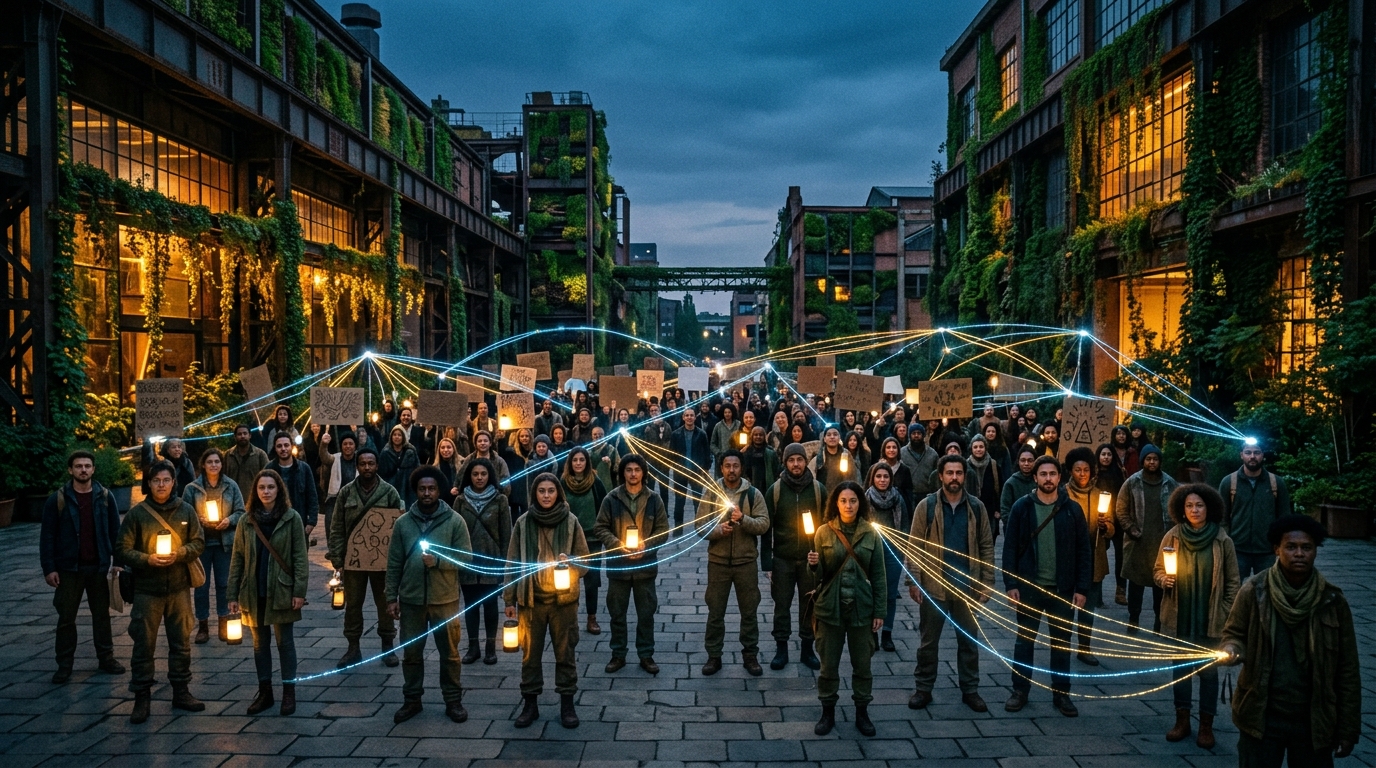
Something unprecedented happened on June 14, 2025. Millions of people across thousands of locations — from small towns in rural America to major cities on multiple continents — gathered under a single banner: No Kings. No single leader called them there. No central organization issued marching orders. They came because a distributed network of autonomous groups, local organizers, and ordinary people decided to act — together, and on their own terms.
This is the architecture of distributed power. And it is one of the most important developments in grassroots activism of our time.
What the No Kings Movement Actually Built
The No Kings movement, coordinated by coalitions like the 50501 Movement, Indivisible, and MoveOn, made a deliberate strategic choice: reject the single-leader model entirely. Organizers called it a “leader-full” approach — not leaderless, but distributed, with initiative and authority spread across thousands of local nodes rather than concentrated at the top.
This wasn’t just philosophy. It was survival strategy. Movements with a single charismatic leader are vulnerable — arrest the leader, discredit the leader, and the movement fractures. A distributed network has no such single point of failure. Suppress one node and ten others activate. The No Kings movement drew millions to the streets on June 14, 2025, again on October 18, 2025, and again on March 28, 2026 — each time without a central command issuing orders, each time with local groups adapting tactics to their own contexts.
The results speak for themselves: some of the largest coordinated protests in American history, sustained over more than a year, without a single figurehead that opponents could target.
The Tactical Toolkit: How Distributed Power Works in Practice
Understanding the No Kings movement means understanding the specific tools and practices that make distributed organizing possible. These aren’t abstract principles — they are concrete methods any community can adopt.
1. Network Thinking Over Hierarchy
Traditional organizations concentrate knowledge and decision-making at the top. Distributed networks push both outward. Every node — every local group, every individual — is empowered to act, experiment, and share what works. The result is rapid tactical adaptation: when one approach gets blocked, the network finds another. No permission required. No bottleneck at the top.
2. Popular Assemblies and Direct Democracy
No Kings chapters across the country established local assemblies — open, participatory spaces where community members could deliberate, decide, and act together. These assemblies aren’t just symbolic. They are functional governance structures that build the habits of democratic participation and create resilient local infrastructure that persists between large actions.
3. Encrypted Communication and Decentralized Media
Coordination at scale without central infrastructure requires the right tools. Signal and Telegram provided encrypted channels for local organizing. Mastodon, Bluesky, and PeerTube offered alternatives to corporate platforms that can be deplatformed or censored. When your communication infrastructure is distributed across dozens of independent servers and apps, no single shutdown can silence the network.
4. Dual Power: Building Parallel Institutions
The most sophisticated distributed movements don’t just protest — they build. Mutual aid networks, community land trusts, worker cooperatives, and community-owned media outlets create what organizers call “dual power”: alternative institutions that meet community needs outside existing power structures. These aren’t replacements for political action; they are its foundation, creating the material conditions under which people can afford to resist.
5. Nonviolent Discipline as Strategic Asset
The No Kings movement invested heavily in nonviolent training and de-escalation. This isn’t moral purity for its own sake — it’s tactical intelligence. Nonviolent discipline denies opponents the justification for repression, maintains broad coalition support, and keeps the focus on the movement’s message rather than isolated incidents. Every participant trained in de-escalation becomes a force multiplier for the entire network.
Digital Tools That Amplify Distributed Organizing
The infrastructure behind modern distributed movements has matured significantly. A few tools worth knowing:
- Action Network and NationBuilder: Platforms that enable decentralized groups to coordinate campaigns, track engagement, and integrate with legislative advocacy tools — without requiring a central database controller.
- Signal: End-to-end encrypted messaging that keeps local organizing communications private and secure.
- Geo-targeting advocacy tools: Software that automatically connects supporters with their specific elected officials, enabling hyper-local pressure campaigns at national scale.
- Mastodon and Bluesky: Federated and decentralized social networks where no single corporation controls the infrastructure — and no single corporation can shut it down.
The Architecture Holds
What the No Kings movement demonstrated, above all else, is that distributed power is not a weakness. Critics predicted that leaderless organizing would dissolve into chaos, that without central direction the movement would fragment and fade. Instead, it grew. It adapted. It returned, again and again, larger each time.
This is the architecture of resilience. When power is distributed — when every community, every local group, every individual holds genuine agency — the system becomes antifragile. Pressure doesn’t break it. Pressure strengthens it.
The tactics are available to everyone. The tools are accessible. The model has been proven at scale. What remains is the decision to build — not to wait for a leader to arrive, but to become, together, the leadership the moment requires.
No kings. No single points of failure. Just people, organized.