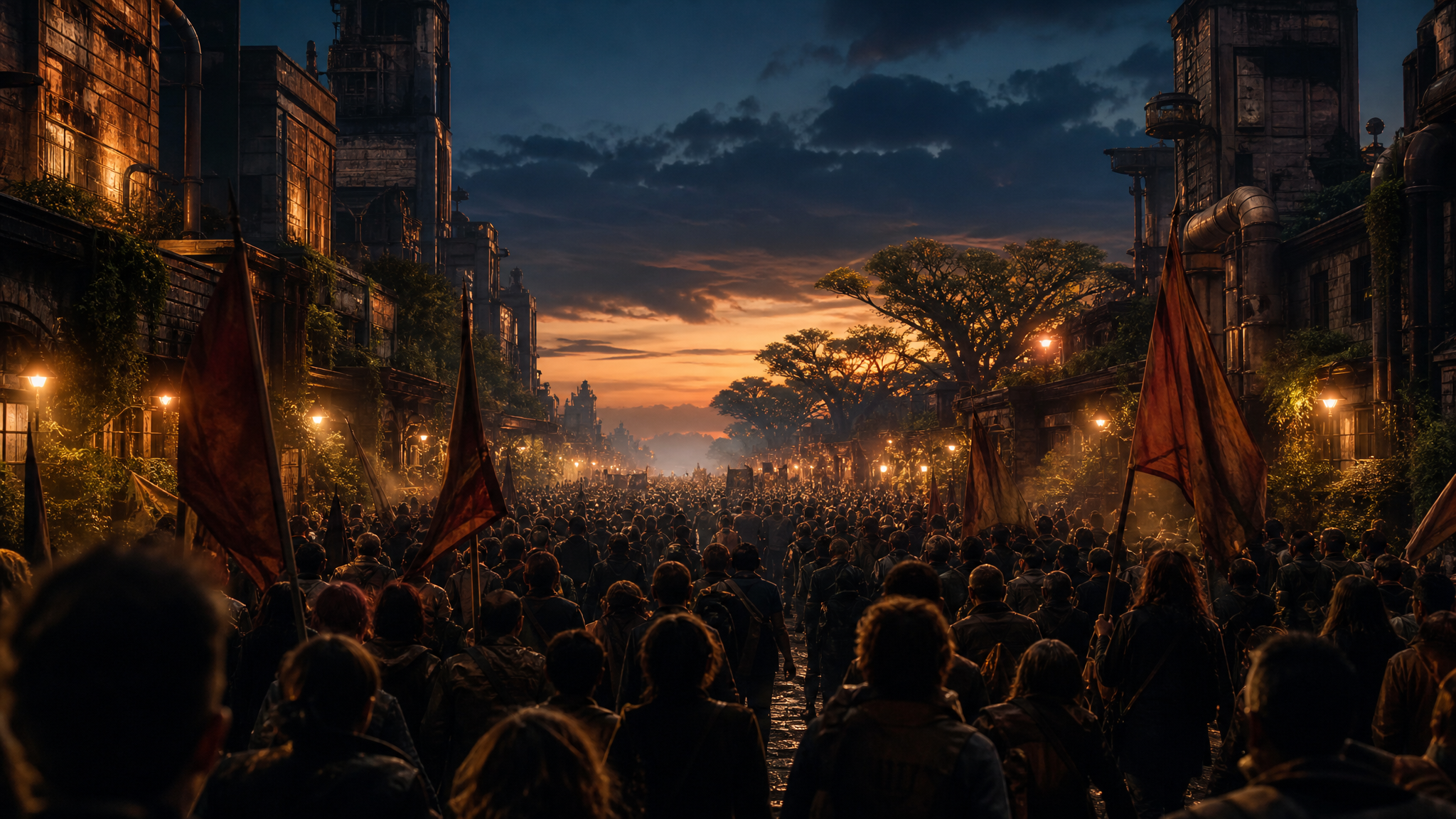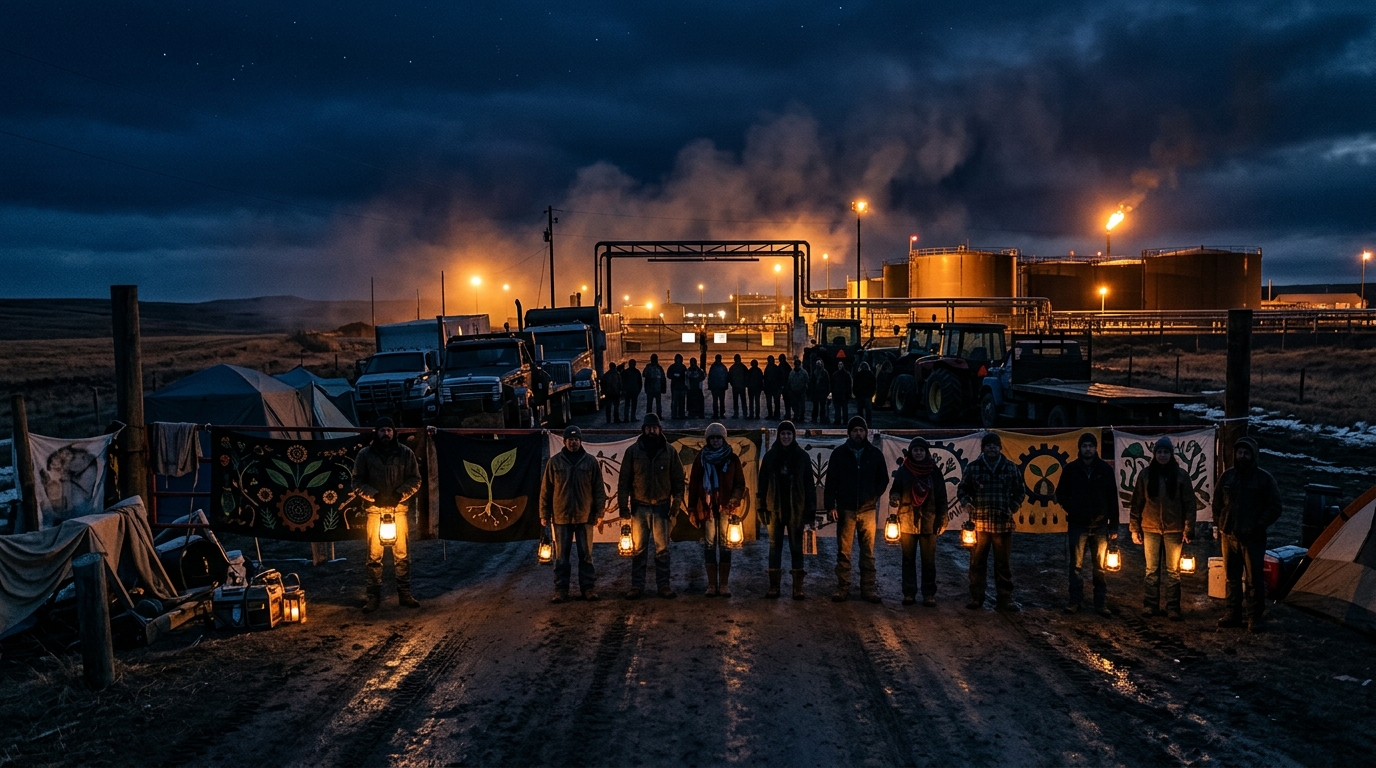
There is an old theory of power that says every movement has a head. Find the head, cut it off, and the body falls. Arrest the organizer. Deplatform the leader. Freeze the accounts. It is a clean, surgical logic—and it is rapidly becoming obsolete.
Ireland Grinds to a Halt Without a Headquarters
In the second week of April 2026, Ireland experienced something the government could neither negotiate with nor easily suppress: a seven-day blockade of major roadways and fuel depots, organized almost entirely through WhatsApp groups and social media threads. Farmers, truckers, and agricultural contractors—people with no shared union, no central organizing body, no single spokesperson—brought the country to a standstill. Six hundred fueling stations ran dry. The Whitegate refinery, Ireland’s only oil refinery, was blockaded. Protesters in Galway and County Limerick held fuel depots for days.
The Irish Minister for Justice, searching for someone to blame, pointed to “outside actors” and far-right agitators. But the movement defied such easy framing. It was a spontaneous coalition born of economic pressure—skyrocketing fuel prices in the wake of ongoing geopolitical conflict, converging with years of soaring cost of living and deteriorating public services. The demands were immediate and concrete: price caps, excise relief, carbon tax cuts. But the structure was something older and stranger—a swarm with no queen. You cannot arrest a WhatsApp group. You cannot defund a network that has no bank account.
Generation Z and the Architecture of the Leaderless
The Ireland protests did not emerge in isolation. They are one data point in a global pattern that analysts at the Heinrich Böll Foundation recently described as a defining feature of Generation Z organizing: conspicuously leaderless, deliberately horizontal, and increasingly effective at scaling without formal institutions. Born into permanent crisis—climate breakdown, widening inequality, the normalization of war through endless scrolling—Gen Z activists have developed a different relationship to power structures than any previous generation. They do not trust institutions enough to route their energy through them. They have watched those institutions fail, be captured, or become outright hostile.
What has emerged instead is a politics of the distributed network. Protests increasingly draw inspiration across borders through viral images, memes, and shared symbols. The Straw Hat Pirates’ Jolly Roger from the manga One Piece—a story about collective rebellion against an autocratic world government—has become a recurring emblem at demonstrations from Southeast Asia to South America. These are not accidents of youth culture. They are political technologies: visual languages that enable recognition and solidarity without requiring identical contexts, identical demands, or identical leadership structures. The message travels; the hierarchy does not.
The Strategic Logic of Having No Head
Horizontality carries real strategic advantages that traditional movements took decades to understand. A leaderless network is genuinely harder to decapitate. There is no charismatic figure whose arrest collapses momentum, no headquarters whose seizure ends the campaign. Repression, rather than stopping the movement, often spreads it—each crackdown becomes a new node of outrage that recruits from communities who were not previously engaged.
But the Heinrich Böll analysis is honest about the costs. Message discipline is harder without a center. Negotiations become nearly impossible when no one can credibly speak for the whole. Translating protest energy into lasting institutional change—the long, grinding work of building power that outlasts any single moment—remains the unresolved challenge. The Irish blockade ended not with victory but with talks that produced no formal agreement, the energy dissipating as protesters returned to their farms and trucks, aware that the underlying pressures remain unchanged.
Building Permanence Into the Horizontal
The question facing decentralized movements in 2026 is not whether horizontal organizing works—clearly, it does, in ways that vertical structures cannot. The question is how to build permanence into the distributed, how to carry the momentum of a seven-day blockade into the slower, less cinematic work of lasting change. Some answers are beginning to emerge. Legal frameworks for Decentralized Autonomous Organizations—like Alabama’s new DUNA Act, making it the second U.S. state after Wyoming to recognize DAOs as legal entities—point toward structures that can hold property, enter contracts, and operate sustainably while preserving the governance principles of the network. Mutual aid infrastructures, built during the pandemic and deepened since, provide material networks that outlast any single campaign.
And there is something to be said for the permanence of culture itself. The memes travel. The songs remain. The Jolly Roger gets raised again at the next demonstration in a different country, by people who never met anyone from the last one. This is not nothing. It may, in fact, be the connective tissue of something the old models of movement-building never quite accounted for: a resistance that persists not through institutions but through shared imagination, refusing to be legible enough to be destroyed.
The head they cannot cut off is the one that was never there. And more people, in more places, are beginning to understand exactly what that means.