

The New Means of Production
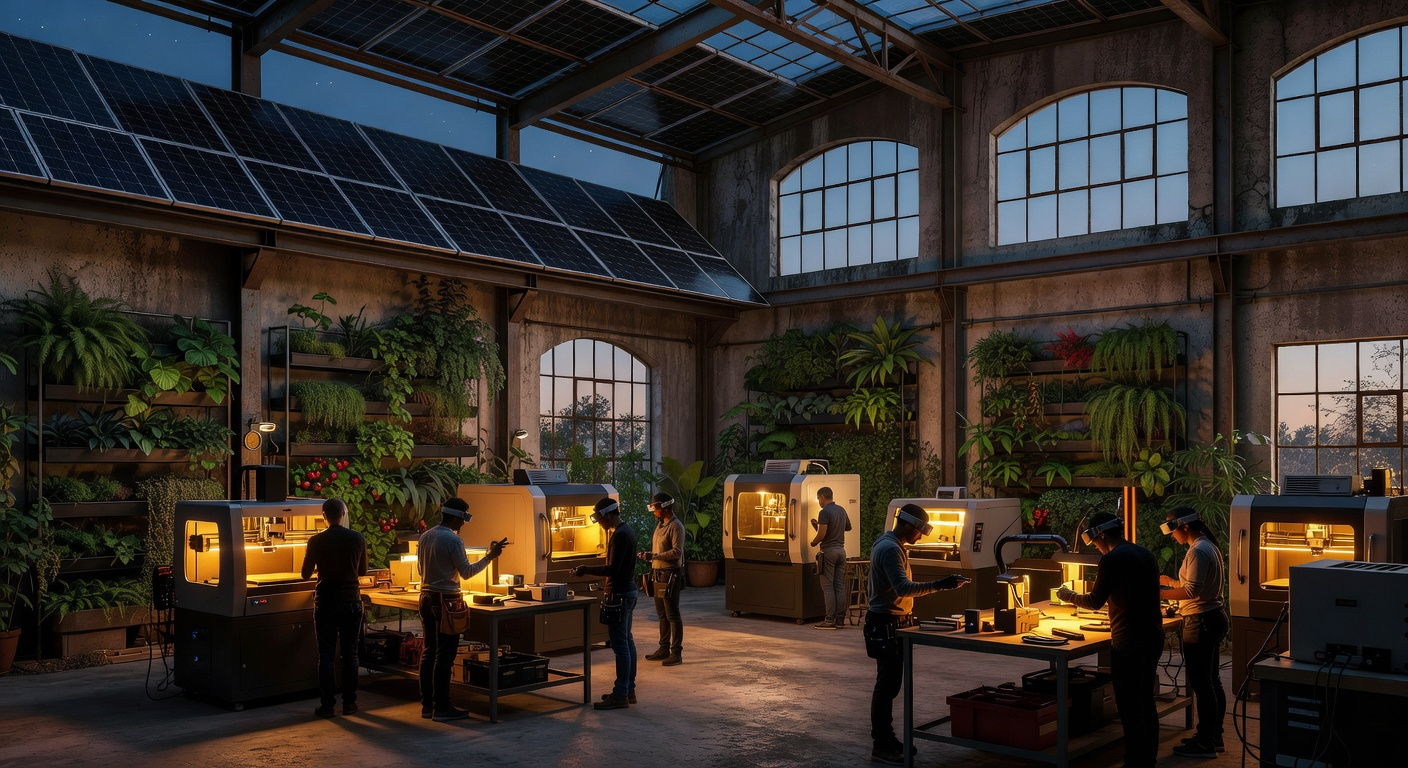
In cities across the globe, warehouses once abandoned to rust and silence are humming again. Not with the roar of industrial giants, but with the steady whir of 3D printers, laser cutters, and CNC mills running on open-source code. These are not factories in the old sense. They are nodes in a distributed network of makers, hackers, and organizers who understand that control over the means of production is not a theoretical demand — it is a survival strategy.
From Fab Labs to Freedom Labs
The Fab Lab movement, born at MIT nearly two decades ago, has evolved far beyond its academic origins. In 2026, the most vital fabrication spaces are those embedded in mutual aid networks, climate justice hubs, and autonomous community centers. They produce everything from replacement parts for aging infrastructure to medical devices that hospitals refuse to supply in under-resourced regions. The code is shared. The designs are forked. The knowledge is treated as a commons, not a commodity.
What distinguishes these spaces from both corporate makerspaces and traditional manufacturing is their explicit political orientation. They exist not to accelerate consumption or generate venture returns, but to reduce dependency on systems designed for control. When a community can print its own water filtration components, repair its own mobility aids, and fabricate tools for direct action without waiting for supply chains or state approval, it has taken a step toward genuine autonomy.
The Material Basis of Solidarity
Mutual aid has always been constrained by material limits. Food distribution networks collapse when delivery trucks are blocked. Medical clinics run out of specialized equipment. Protest infrastructure disintegrates when suppliers cut access. Open-source manufacturing directly addresses these vulnerabilities by localizing production capacity and democratizing the knowledge required to use it.
The most sophisticated networks now operate as federated systems. A design created in a Barcelona cooperative can be downloaded, adapted, and produced in a Detroit community workshop the same day. Version control replaces supply chain management. Forking becomes a form of adaptation rather than fragmentation. The result is a resilient web of production that can route around blockades, sanctions, and corporate withdrawal.
Against the Enclosure of Everything
Capitalism has spent centuries enclosing the commons — land, seeds, medicine, even genetic code. The response has been enclosure of a different kind: the hoarding of technical knowledge behind patents, NDAs, and proprietary formats. Open-source manufacturing reverses this logic. It treats blueprints as seeds to be shared, not treasures to be guarded. Every design released under a copyleft license becomes a small act of reclamation.
This is not naive idealism. The most effective distributed manufacturing networks maintain rigorous quality control, document their processes meticulously, and build reputations through demonstrated reliability. They understand that trust is earned through competence. The radical claim is not that anyone can make anything, but that communities can develop the capacity to meet their own needs without begging permission from gatekeepers.
The Solarpunk Horizon
Walk into one of these spaces at dusk and you will see it: the solarpunk future taking shape in the present. Solar panels on the roof power the machines. Vertical gardens grow along the walls. The air smells of solder, soil, and possibility. People who have been told they are surplus to the economy are building the infrastructure of a different world — one where production serves life rather than the reverse.
The machines themselves are often salvaged, repaired, and upgraded with open-source components. Nothing is wasted because nothing is designed for obsolescence. The aesthetic is not the sterile minimalism of corporate innovation labs, but the resourceful beauty of things made to last and made to be understood. Every exposed wire and labeled component is an invitation to participation.
Building While Fighting
Distributed manufacturing is not a substitute for direct action, but its material foundation. When organizers can produce their own banners, shields, communication devices, and medical supplies, they reduce their exposure to surveillance supply chains and corporate retaliation. The same tools that build autonomy also build the capacity to resist.
The networks growing in 2026 are not waiting for permission or funding. They are stitching together a parallel infrastructure — one node at a time, one shared design at a time, one community workshop at a time. In doing so, they are proving that another world is not only possible, but already under construction.