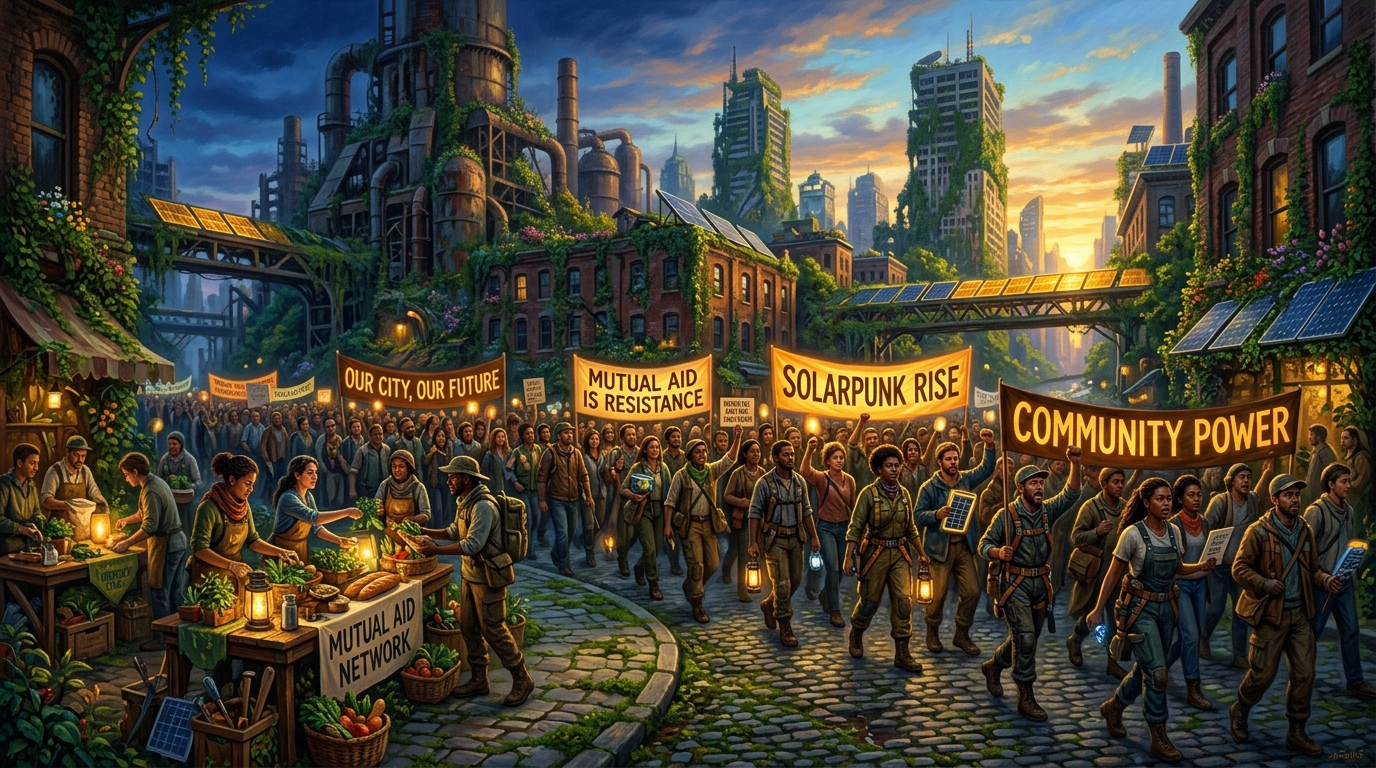
Something extraordinary happened on March 28, 2026. An estimated eight to nine million people flooded the streets of the United States and fifteen countries around the world — not summoned by a single charismatic leader, not organized from a gleaming headquarters, not funded by a billionaire with a brand to protect. They came because they chose to come. They stayed because they chose to stay. The “No Kings” movement, now one of the largest sustained protest waves in American history, has become an extraordinary living experiment in what power looks like when it refuses to have a face.
The Architecture of a Movement Without a Center
Conventional political wisdom insists that movements need figureheads — someone to negotiate with, someone to vilify, someone to arrest and thereby decapitate the whole organism. The No Kings movement, organized through distributed networks like the 50501 coalition, Indivisible chapters, and thousands of autonomous local cells, has deliberately built itself to resist that logic. There is no single throat to choke. There is no headquarters to raid. When one node is pressured, the network routes around it.
This is not accidental. The architecture is the politics. Organizers have spoken openly about designing for resilience rather than efficiency — accepting the slower, messier process of consensus and local autonomy because they understand that anything built around a single point of control will, eventually, be captured or crushed by that control. The rallies taking place across more than 3,300 sites — in suburbs, small towns, and city centers alike — are not logistical inefficiencies. They are the point. Every local rally builds a local network. Every local network builds durable civic infrastructure that outlasts any single protest day.
From Mass Mobilization to Sustained Power
The harder question, the one organizers are wrestling with openly as they plan the May Day Strong collective action on May 1st, is how a leaderless movement transforms street energy into durable structural change. History is littered with mass mobilizations that burned bright and collapsed into exhaustion, leaving behind no lasting organization, no leverage, no negotiating position. The No Kings movement is self-conscious about this failure mode in a way that previous cycles of protest were not.
What is emerging in the spaces between the protest days is something less telegenic but potentially more powerful: mutual aid networks being knitted together, tenant unions being organized, local electoral races being contested by people who cut their political teeth holding signs in the rain. The distributed nature of the movement is producing distributed infrastructure — not one big machine, but thousands of small ones, each rooted in the specific conditions of its place. This is the solarpunk principle applied to political organizing: resilience through diversity, strength through rootedness, power through connection rather than concentration.
The Global Mirror
The No Kings energy is not uniquely American. In Myanmar, Shan and Karenni resistance forces established new unified military structures in April to continue their fight against the junta that has held the country in a stranglehold since the 2021 coup — another example of groups finding ways to coordinate resistance without ceding sovereignty to a single command structure. In Ireland, a decentralized coalition of farmers, truckers, and agricultural workers shut down roadways and fuel depots for days, fighting both an economic crisis and the far-right’s attempts to co-opt their anger into something uglier. Across the world, from climate blockades to press freedom campaigns to labor organizing drives, the same pattern appears: people building power horizontally because they have learned, through painful experience, what happens when they concentrate it vertically.
The governments responding to these movements have noticed the pattern too — and the backlash has been systematic. New legislation in multiple countries is targeting protest rights specifically, imposing severe penalties on climate activists, pro-Palestine demonstrators, and other movements deemed inconvenient to power. The criminalization of dissent is itself a kind of tribute: it acknowledges that what is happening in the streets is genuinely threatening to established order.
What Comes After the March
The most radical thing the No Kings movement is doing is not the marches themselves. It is the insistence, articulated by organizers across the country, that the goal is not to petition power but to build an alternative to it. “Mass defiance and local power” — the movement’s own framing — contains within it a vision of politics that does not depend on waiting for elected officials to act. It is a politics of doing: building the mutual aid networks, the community defense structures, the cooperative economic institutions, and the digital infrastructure of privacy and autonomy that make communities less dependent on and therefore less controllable by concentrated power.
That work is unglamorous. It does not trend. It does not produce the kind of images that go viral. But it is, in the long arc of social transformation, the work that actually changes things. The people filling the streets are not naive about power. They are learning, rapidly and under pressure, how to build it — distributed, resilient, and rooted in the places where they live. That is what an uprising that cannot be decapitated looks like. That is what freedom being practiced, not just demanded, looks like. And it is only just beginning.