When Workers Shut It Down: Solidarity as the Only Language Power Understands
There is a moment in every labor struggle when the math becomes undeniable. When the equations of fear — fear of deportation, fear of eviction, fear of the empty refrigerator — collide with an older, deeper arithmetic: the arithmetic of collective power. That moment happened twice this summer in ways that deserve to be named, remembered, and built upon.
In the Twin Cities, when ICE agents began their “Operation Metro Surge” — smashing car windows to drag rideshare drivers through them, circling immigrant workers outside the stores where they labor, arresting airport workers who had full federal background clearances but the wrong skin tone — it would have been easy for SEIU Local 26 to retreat into pure mutual aid mode. To run the emergency rides, the legal funds, the translation hotlines. And they did all of that. But they also asked a harder question: can you service your way out of an authoritarian occupation? The answer, written in the tears of supervisors and the shaking hands of workers in a Zoom meeting held because people were too afraid to leave their homes, was no. The answer had to be the withdrawal of labor. A day of no work, no school, no shopping — not a symbolic gesture but a demonstration of the one power that cannot be surveilled away or legislated out of existence.
What made Minnesota’s organizing remarkable was not just the courage of the moment but the years of muscle memory behind it. SEIU Local 26 had gone on strike before — many times, in contract fights that stretched the workers’ capacity to its limit. They had practiced the thing. And so when the moment came that was larger than any contract, when the stakes were the physical safety of their community, they already knew how to do it. The infrastructure of solidarity — the stewards, the coalition relationships, the analysis of how authoritarian playbooks work — was already in place. You can’t build that the week you need it.
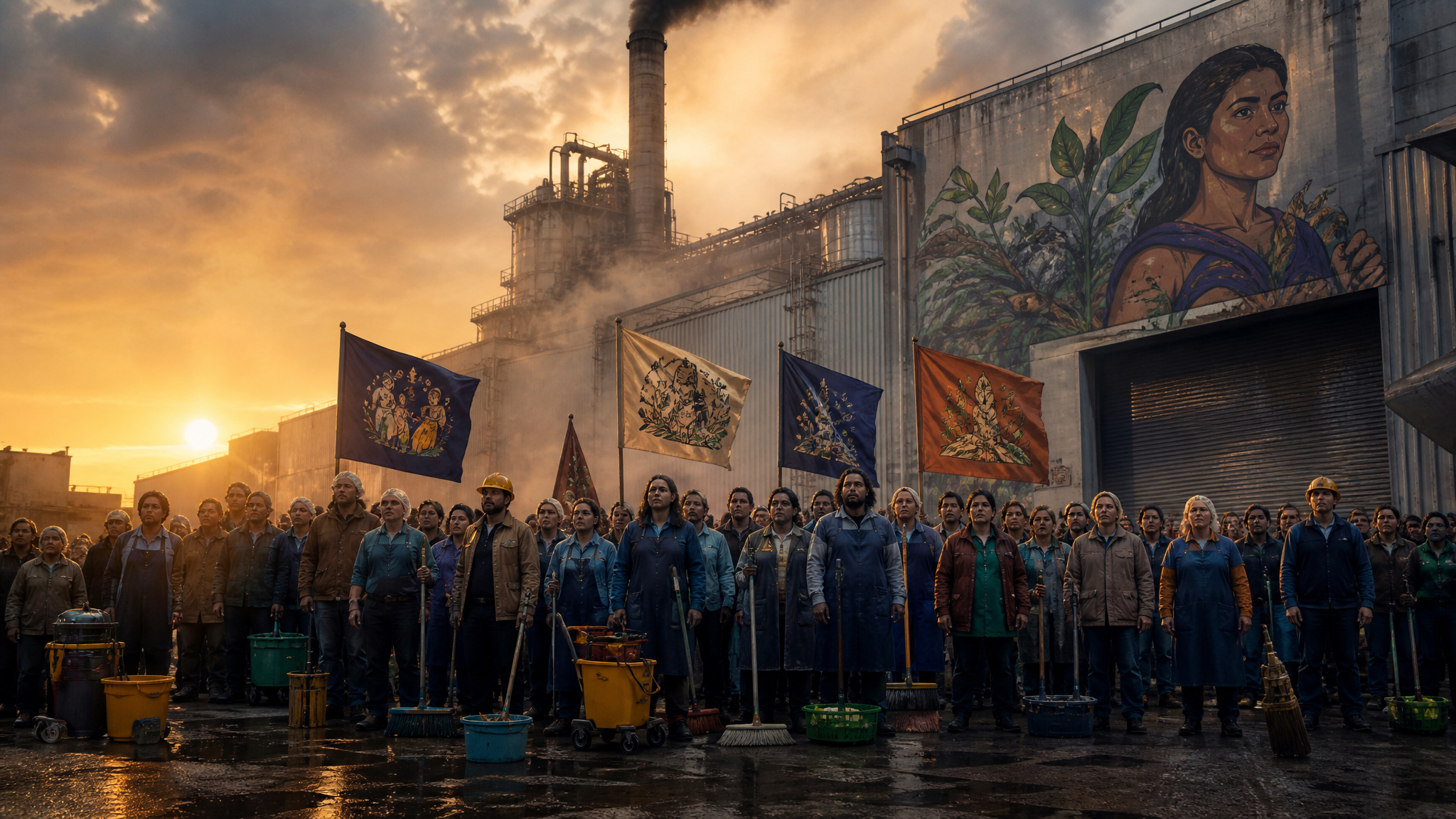
Meanwhile, in Joslin, Illinois, a different kind of violence unfolded. On August 13, 2,500 workers — janitors of the meat industry, people from Togo and Burma and Latin America who had spent years checking cattle teeth and racing conveyor lines and absorbing injuries in silence — arrived for their shifts to find the plant closed. No warning. No reason given. Just two supervisors crying and a parking lot full of car accidents as people drove away in shock. Tyson Foods, the company that made billions off their labor, handed them 36 hours of partial pay and the door. Workers like Ahoro Asselissime, who gave 11 years of his life to the company, received $500 that week. His rent was $925.
The corporate logic on display in Joslin is worth sitting with. The cattle shortage driving the closure is real, but it is not an act of god — it is the downstream consequence of corporate consolidation, drought made more severe by the climate crisis, and fuel costs inflated by war. The workers who built Tyson’s profit margin for decades are now paying the price for decisions made in boardrooms they were never invited into. This is how monopoly capitalism works. It socializes its costs while privatizing its gains, and the people absorbing the cost are always the ones with the least cushion to absorb it.
But here is what the Joslin story also contains: Nana Ouro-Agoro and Akwaaba. For years before the plant closure, this community organization — founded by a Togolese immigrant who won the lottery and found her neighbors being treated “worse than cattle” — had been doing the unglamorous work of relationship-building. Translation services. Rights education. The slow, painstaking labor of trust across language and culture and fear. When the crisis hit, Akwaaba’s 500 affected clients didn’t face it alone. The infrastructure was there. Imperfect, underfunded, stretched thin — but there.
And then there are the baristas. As of late August, Starbucks Workers United — five years into a campaign that has unionized over 700 stores and accumulated 550 unfair labor practice charges against the company — launched a boycott aimed not just at individual consumers but at institutions. The AFL-CIO signed on. The Chicago Teachers Union voted to join. The ask is simple and clarifying: no contract, no Starbucks coffee at the union hall. No catering contracts. No sponsorships. The corporate strategy of endless delay and legal obstruction only works if the social and economic cost of that delay stays low. The boycott is designed to change that calculus.
What these three stories share — the Minnesota general stoppage, the Joslin closure and community response, the Starbucks boycott — is an understanding of power that goes beyond the ballot box and the press release. It is a power built from relationship: the kind that knows which workers will walk out and which organizations will honor a boycott, because those relationships were forged before the crisis, not during it.
The authoritarian playbook relies on atomization. It wants workers afraid to leave their homes, immigrant communities cut off from their neighbors, service employees too exhausted and underpaid to imagine anything beyond survival. The counter-playbook has been the same for 150 years: find each other. Build the muscle. Practice the withdrawal. Extend the coalition one relationship at a time, until the moment arrives when you need it — and you discover, with something that feels very much like grace, that you are not alone.
That moment is not coming. It is already here.