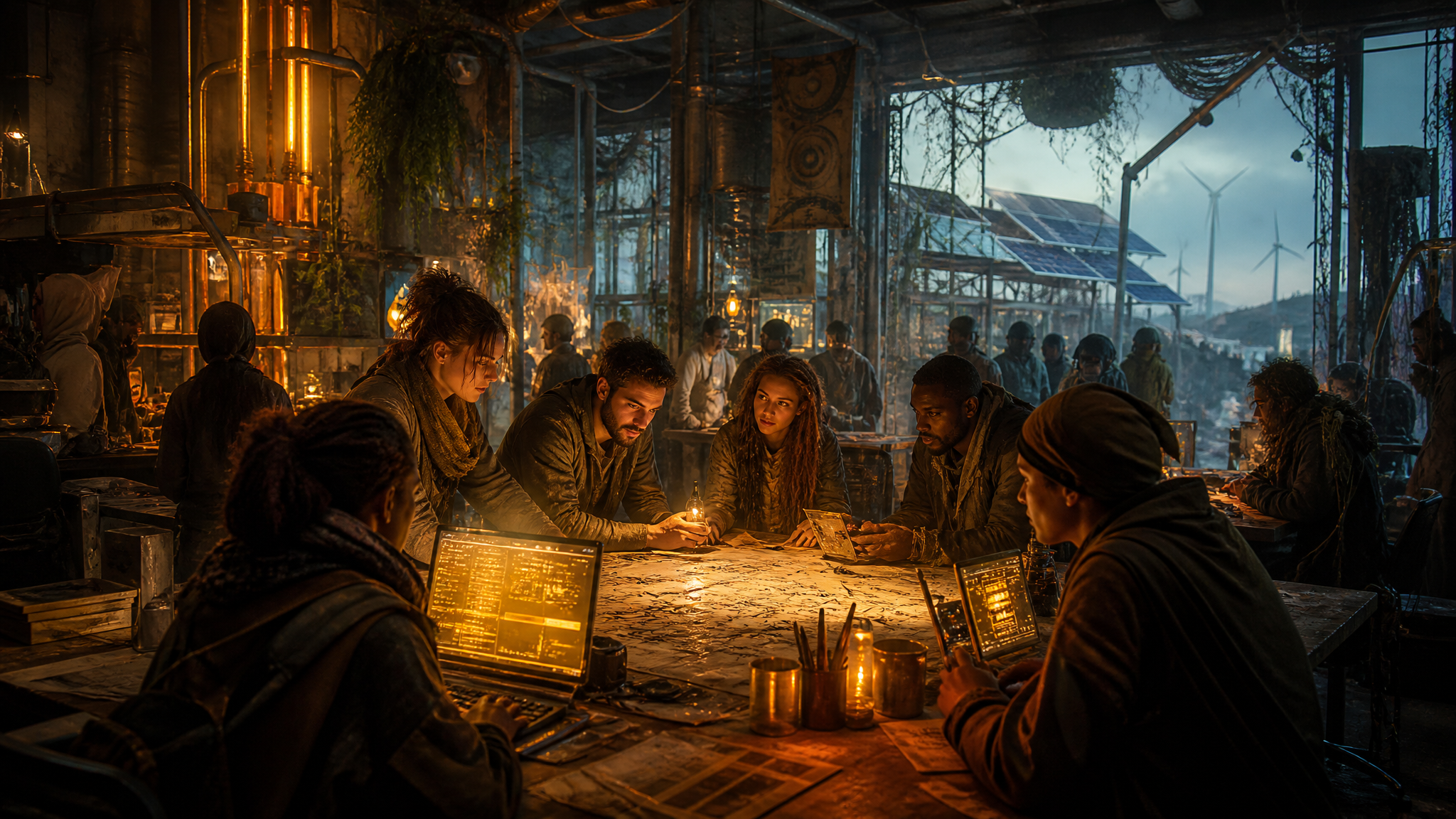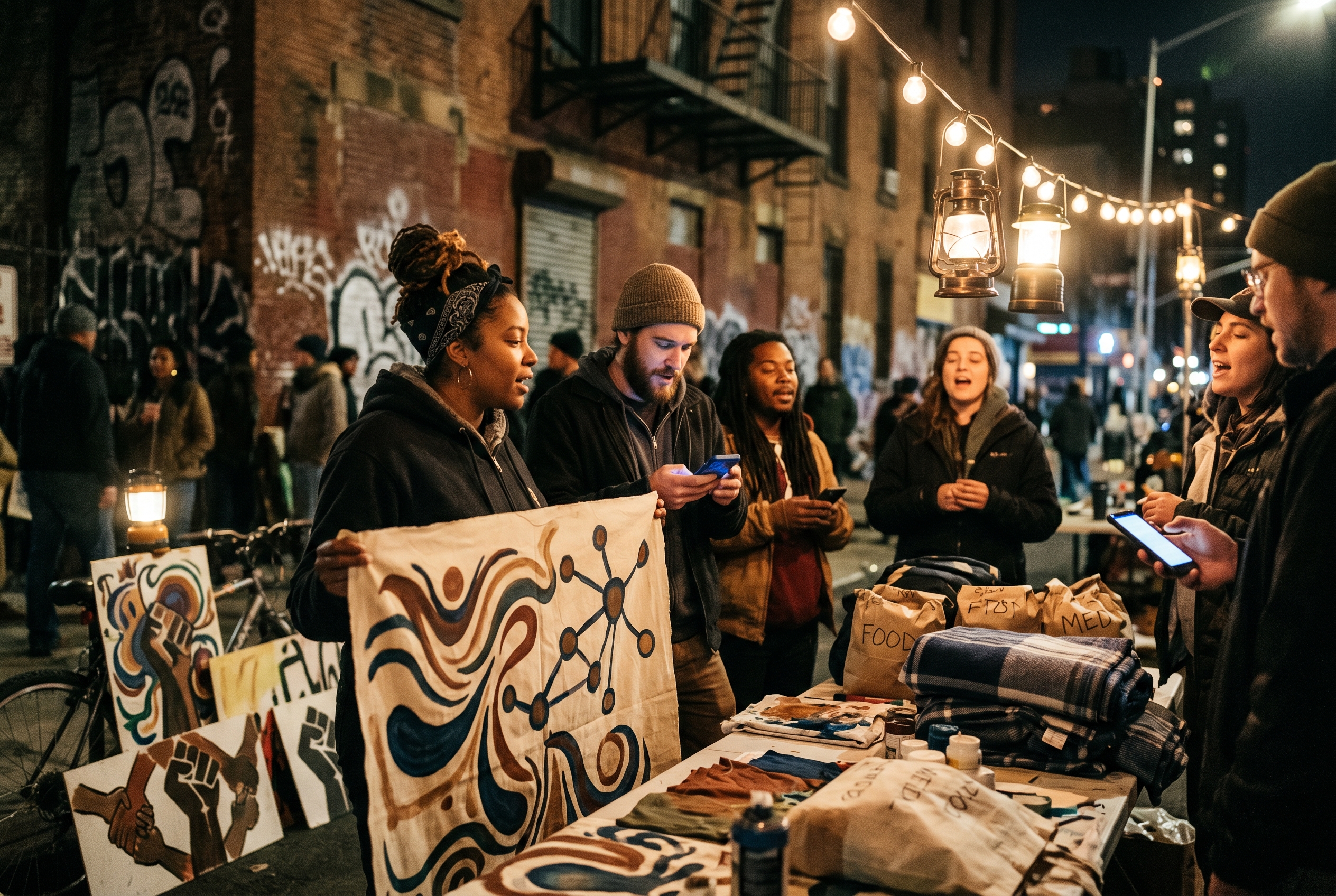
From neighborhood signal chats to song-led street actions, the strongest movements are building distributed systems of care, communication, and pressure.
The last wave of organizing has clarified something every serious movement eventually learns: centralized outrage is easy to crush, but distributed capacity is much harder to break. Across anti-deportation organizing, creative street resistance, and local fights against extractive AI infrastructure, communities are rediscovering an old truth in modern form. The point is not simply to mobilize faster. The point is to become structurally harder to intimidate, isolate, or exhaust.
That means treating resistance less like a spectacle and more like a durable operating system.
1. Build small nodes, not one giant machine
Some of the most effective recent grassroots responses have not depended on a single organization, charismatic leader, or central command. They have grown through local alliances, vetted neighborhood chats, mutual aid crews, faith communities, artists, and rapid-response volunteers. This matters because resilience comes from redundancy. When one node gets overwhelmed, others can still move.
Practical lesson: organize in layers. Keep a public-facing layer for outreach, narrative, and recruitment. Keep a trusted coordination layer for logistics. Keep specialized circles for legal support, care work, documentation, creative production, and neighborhood response. Not everyone needs access to everything. Everyone does need a clear role.
- Create small teams with named responsibilities.
- Use separate channels for public announcements and sensitive coordination.
- Document basic workflows so activity does not stall when one person burns out.
2. Treat operational security as collective hygiene
Operational security is not paranoia. It is maintenance. Communities responding to repression are increasingly relying on vetted group chats, role-based coordination, and need-to-know sharing for a reason. Security failures usually do not come from Hollywood-style espionage. They come from sloppy habits: oversharing, mixing public and private channels, assuming everyone in a room needs the same information, or leaving one exhausted volunteer to manage everything.
A healthy movement normalizes simple discipline. Verify participants before adding them to sensitive channels. Separate identity, logistics, and media work where possible. Decide in advance who speaks publicly, who documents incidents, and who handles care for people under pressure. Good security is boring on purpose, and that is exactly why it works.
3. Make creativity do strategic work
Minneapolis offered one of the clearest recent examples of creative resistance used well, not as decoration but as leverage. Banner drops, public singing, music, noise demonstrations, protest art, craftivism, and faith-led ceremony all expanded participation while shifting the emotional terrain. These tactics did more than attract attention. They reduced fear, built solidarity, created memorable images, and gave people with different skills a way to contribute.
This is a tactical advantage. A movement that only knows how to march has a narrow bandwidth. A movement that can sing, paint, feed, witness, document, host, design, and disrupt can absorb more people and survive longer.
- Use visual tactics to make your message legible at a distance.
- Use music and collective voice to turn spectators into participants.
- Use humor, craft, and ritual to lower the barrier to entry without lowering seriousness.
4. Connect local pain to structural power
Another important development is the widening resistance to AI buildout through fights over data centers, utilities, water use, noise, land, and public subsidies. This is instructive even beyond tech politics. People often enter struggle through immediate material harms, not abstract ideology. That is not a weakness. It is the beginning of political clarity.
When communities connect skyrocketing bills, environmental strain, surveillance expansion, or labor displacement to centralized power, they create a stronger base than rhetoric alone can provide. The tactic here is translation: make systemic issues concrete, local, and discussable at the kitchen-table level.
5. Design for stamina, not spikes
Most movements do not fail because people care too little. They fail because the structure assumes constant emergency. Durable organizing needs rhythms of escalation, care, training, and recovery. Mutual aid is not separate from strategy here, it is what keeps strategy alive. Food delivery, rides, childcare, emotional support, and accompaniment are not side tasks. They are infrastructure.
If you want a movement that lasts, ask different questions. Not just: how do we get people out this weekend? Ask: who follows up after the action, who notices who disappeared, who trains the next round of volunteers, and who makes sure courage is shared instead of extracted?
The manual going forward
The strongest decentralized movements now understand that resistance is not only protest. It is communications architecture, trust design, story discipline, skill-sharing, and care under pressure. Build many entry points. Distribute responsibility. Make beauty useful. Protect each other. And wherever possible, turn isolated frustration into local, organized capacity.
That is how communities stop being an audience to power and start becoming a force that power has to reckon with.