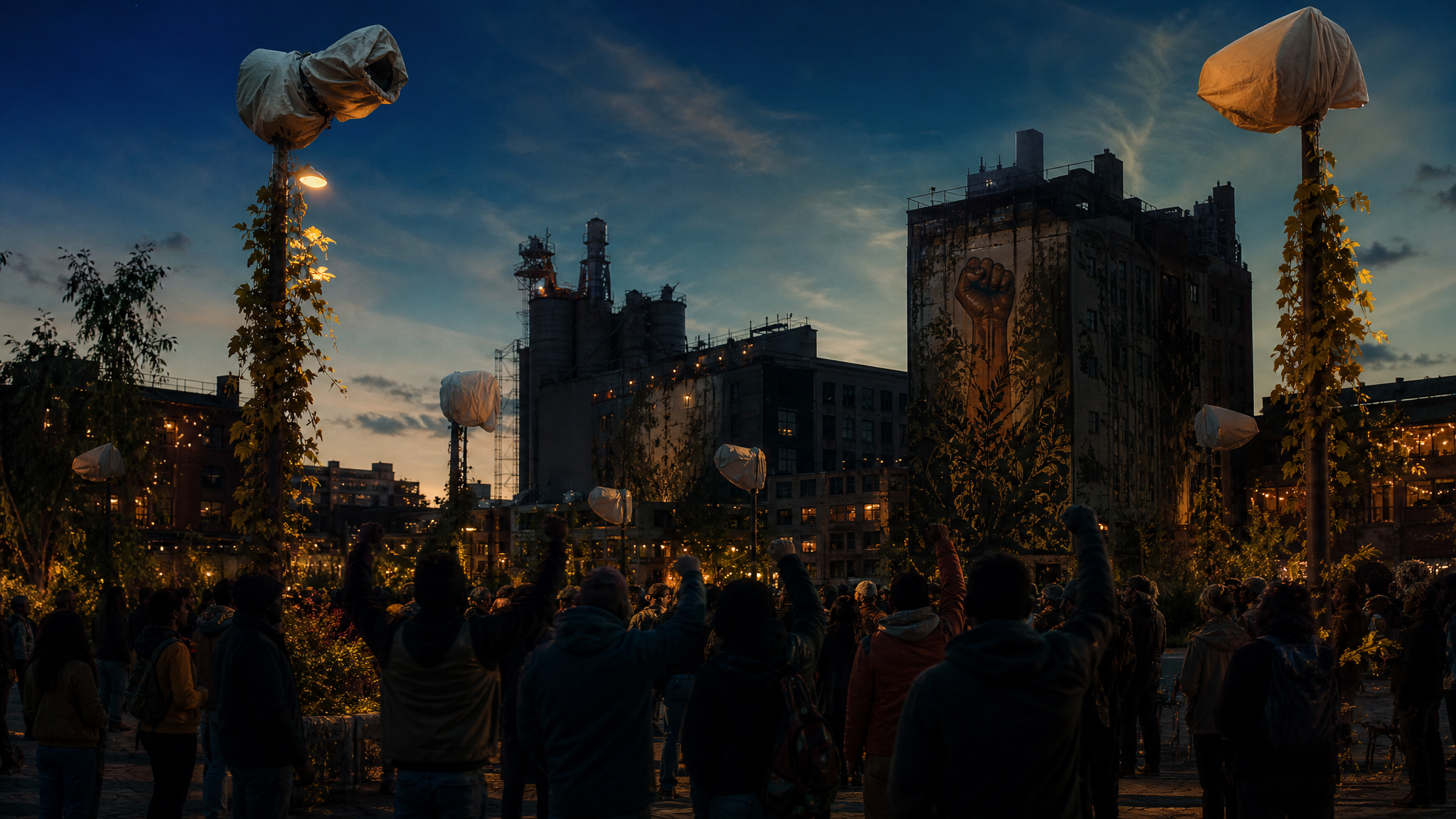
On August 31st, New Orleans said no. Faced with a $300 million federal bribe dressed up as public safety funding, the city of New Orleans refused to apply for the Trump administration’s Model Cities Initiative — a grant program that, buried in its fine print, requires local governments to share immigration data with ICE and the Department of Homeland Security, install mass surveillance infrastructure, and align their policing with a federal agenda that civil rights organizations have described as authoritarian colonialism.
It was a quiet act of defiance from a city that has known too much about what it means to be occupied. But it didn’t happen in a vacuum. It happened because organizers, residents, and advocacy groups rang alarm bells loud enough to be heard. It happened because the people of New Orleans — a majority-Black city with deep roots in civil rights resistance — made it politically impossible to take the money without answering for it.
The Architecture of Control
The Model Cities Initiative is the Trump administration’s blueprint for what it calls “hypervigilant policing.” Its operational template is Memphis, Tennessee — another majority-Black, Democrat-led city in a GOP-controlled state — where 13 federal agencies flooded the streets a year ago under what the White House called a “law enforcement surge.” What residents and civil rights groups actually describe is something far darker: militarized occupation, racial profiling baked into traffic stops, and documented retaliation against Black and Brown residents who tried to record their interactions with officers. Federal task force agents shot and killed at least four Black men in Memphis over a two-month period this summer. In at least two of those cases, autopsies and surveillance footage contradicted the official stories.
This is what the $300 million was meant to replicate. The grant program doesn’t just buy cameras and software — it purchases compliance. It ties financial survival to ideological submission. For cities like New Orleans, already squeezed by a state government hostile to its politics and struggling through a budget crisis, the offer was calibrated to be hard to refuse. The architects of control understand that money is leverage, and leverage is power.
Flock by Flock, Block by Block
The Model Cities money would have gone, in part, toward expanding surveillance networks like Flock Security — a private company whose more than 120,000 cameras now blanket the country, scanning license plates and feeding data into a vast interconnected dragnet. Flock’s investors like to describe this as civilizational progress. “Flock eliminates crime,” announced venture capital firm Andreessen Horowitz, with the breathless certainty of people who have never been profiled. The reality, as revealed by records obtained by The Intercept this week, is that police departments across the country are using Flock’s network to investigate people for the crime of standing around — querying the system under categories like “Curfew/Loitering/Vagrancy Violations.” In one documented case, the Tennessee Bureau of Investigation searched over 17,000 Flock camera networks to investigate a “suspicious person at planned protest site.” Not a crime. Not a threat. A person. At a protest.
The surveillance state is not waiting for a warrant or a threat assessment. It is watching corners, watching gatherings, watching the act of being present while Black or Brown or poor or dissenting. The infrastructure is already there. The Model Cities Initiative was simply the grant mechanism to deepen it — to tie more cities into the network, to normalize the camera on every corner, the face-match at every transit stop, the data trail that follows every body through every public space.
The Refusal as Blueprint
Edith Romero, an organizer with Eye on Surveillance in New Orleans, framed the Model Cities grant plainly: “This means surveillance for Immigration and Customs Enforcement and the Department of Homeland Security to separate families and terrorize our communities.” She and other local advocates spent weeks mapping the strings attached to the money, translating bureaucratic language into its human consequences, and building enough pressure that city leaders could not ignore it.
This is what decentralized resistance looks like in practice. It is not a single dramatic moment. It is the accumulation of meetings, fact sheets, public testimony, relationships, and the slow, stubborn work of making the cost of compliance higher than the cost of refusal. It is organizers who know their city, who understand the levers of local government, who can translate federal policy into neighborhood reality. New Orleans said no because people who knew what “yes” would mean made sure that knowledge was impossible to ignore.
The template matters. Every city that refuses the Model Cities grant is a proof of concept — evidence that the surveillance state’s expansion is not inevitable, that the money is not free, and that local power can hold a line. The federal government is playing a long game of infrastructure: get the cameras installed, get the data-sharing agreements signed, normalize the integration of local police with federal immigration enforcement, and by the time a city wants out, the architecture is already embedded. The answer is to refuse before the architecture arrives.
Building What Cannot Be Surveilled
The deeper question raised by this moment is what communities build in the space they defend. Refusing surveillance money is necessary but not sufficient. The budget crises that make these grants tempting are themselves a form of coercion — austerity wielded as a tool to make communities desperate enough to trade their freedom for funding. The long-term answer is mutual aid infrastructure that doesn’t depend on federal goodwill, community institutions that serve real needs without attaching data hooks, and local networks of solidarity that make the surveillance grant a bad deal even when the money is badly needed.
New Orleans refused one offer. The administration will make more. The surveillance economy is patient, well-funded, and deeply invested in the belief that every community has a price. The work of resistance is to prove them wrong — not once, but continuously, and to build the kind of collective power that makes refusal not just possible but obvious. The cameras are watching. But so are the neighbors. And sometimes, the neighbors win.