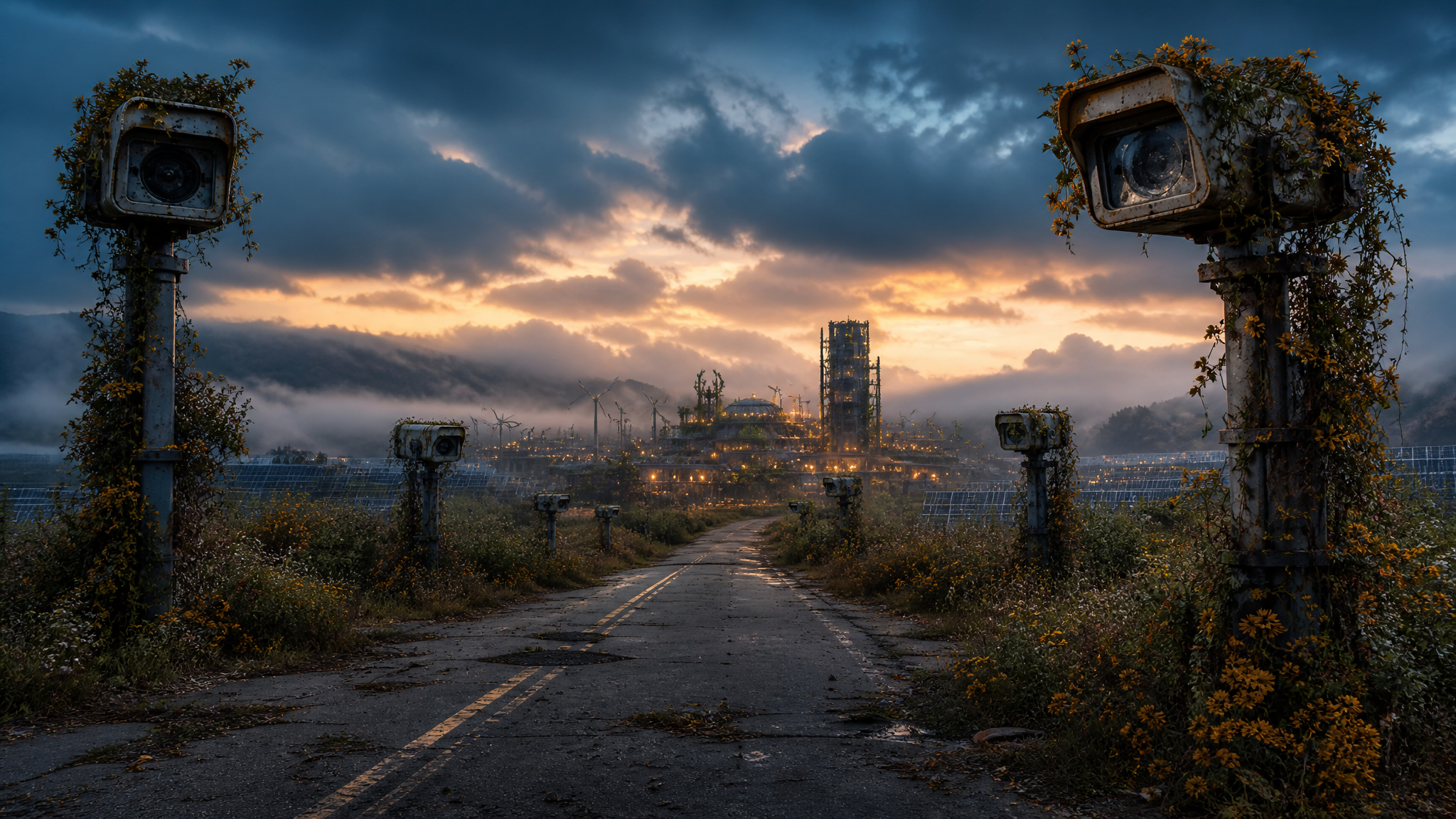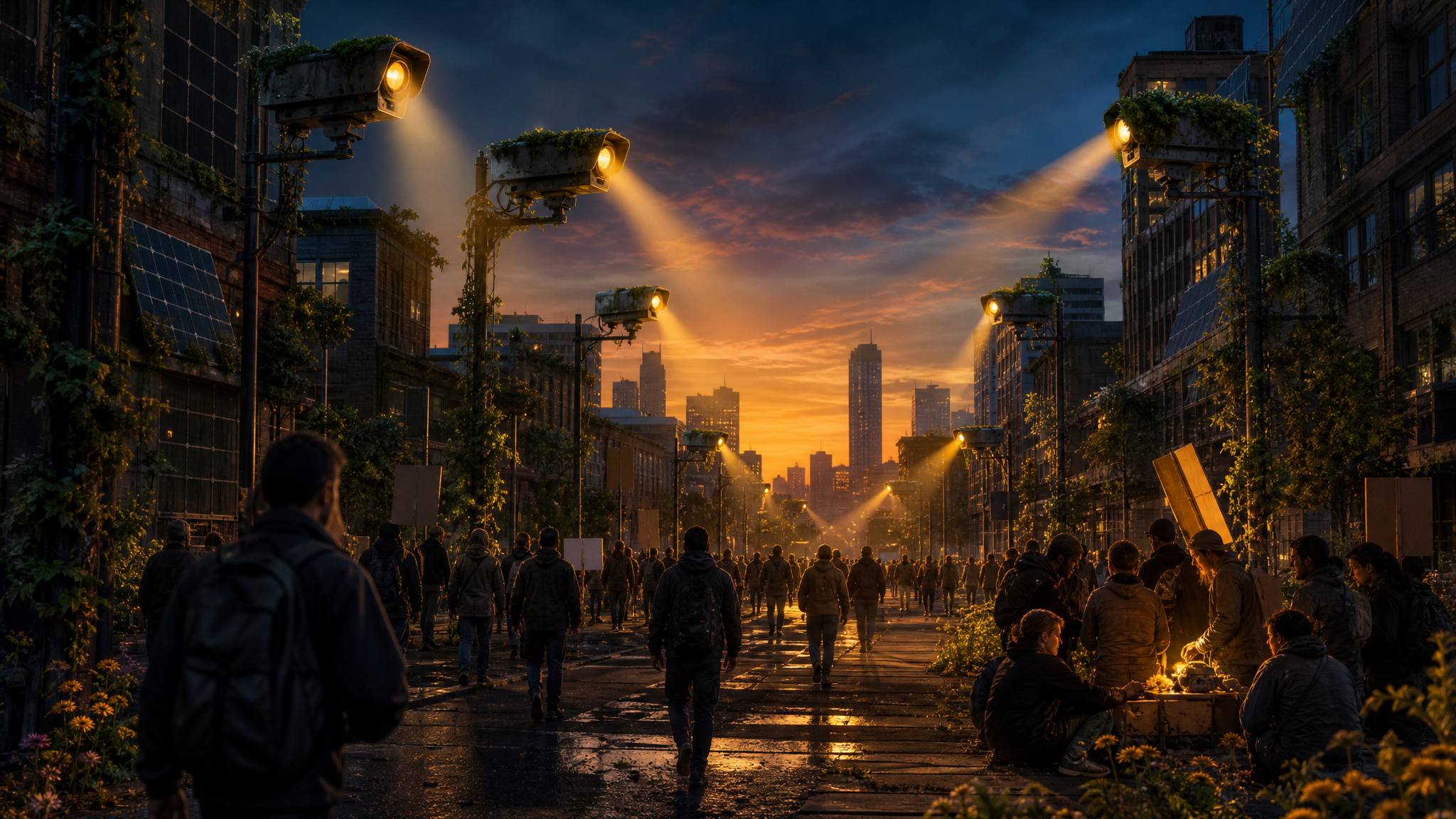
The Grid That Watches You Stand Still
There is a company called Flock Security. Its chief executive says he can think of no greater mission than rescuing children. Its venture capital backers at Andreessen Horowitz declare, without irony, that “decline is a choice” — and that Flock eliminates crime. What they don’t say so easily is what The Intercept’s Sam Biddle documented this week using public records: that Flock’s network of more than 120,000 cameras across the United States is being queried by police departments to investigate curfew violations, loitering, vagrancy — and, explicitly, the presence of people at planned protest sites.
That last entry in the public data deserves to be read slowly: the Tennessee Fusion Center used Flock’s mass surveillance network to search over 17,000 cameras while investigating “Curfew/Loitering/Vagrancy Violations — Suspicious person at planned protest site.” Standing near a demonstration, in a country that still nominally enshrines the right to assemble, has become grounds for a dragnet that touches the license plates and faces of every person who walked past one of more than seventeen thousand cameras in that moment.
Infrastructure as Ideology
What Flock represents is not merely a product. It is a vision of the city as a sorting machine. The infrastructure of daily movement — streets, intersections, parking structures, public parks — is being quietly converted into a continuous audit of who is where, doing what, for how long. The camera doesn’t ask if you have a reason to be standing on a corner. It doesn’t need to. The data is logged, searchable, and shareable across jurisdictions in seconds. A Georgia police department, 600 miles from its home turf, can tap into the Plano, Illinois, camera grid on a Tuesday morning to find out who was standing suspiciously near anything, anywhere on that network.
This is the architecture of control that has historically been reserved for authoritarian states. Now it is being sold to American municipalities as a public safety subscription service, wrapped in the language of child protection and backed by some of the most powerful venture capital money in Silicon Valley. The cameras do not announce themselves as political instruments. They simply watch — and the watching itself reshapes what is possible in public space.
When the Protest Site Becomes a Crime Scene in Advance
The revelation about protest surveillance cuts to the heart of what this infrastructure means for organized resistance. Movements depend on people gathering — in parks, on corners, outside government buildings, in parking lots before a march. Every one of those gatherings is now potentially a data collection event. Every car that drove by, every face that passed in frame, every phone that pinged a nearby tower is a thread that a fusion center can pull later.
Fusion centers — the joint federal-state intelligence sharing hubs that proliferated after 9/11 — have a documented history of treating lawful political activity as a threat to be monitored. The Tennessee Fusion Center’s Flock search is not an anomaly. It is the mundane, bureaucratic face of a surveillance architecture that has been under construction for two decades, now supercharged by private infrastructure that operates outside the oversight frameworks that at least nominally constrain direct government surveillance.
Flock is private. Its cameras are often on private property. Its data-sharing agreements are written in terms of service, not law. The constitutional guardrails that apply — imperfectly, unevenly — to government surveillance have not caught up with the hybrid public-private panopticon that companies like Flock have built. And Andreessen Horowitz is not particularly worried about that gap. Decline, after all, is a choice. Resistance, apparently, is a loitering violation.
The Counter-Architecture of the Unwatched
None of this is inevitable. The infrastructure of control is not natural law — it is a set of choices made by city councils, police departments, and private investors, and choices can be unmade. Across the country, communities have fought back against automated license plate readers, facial recognition contracts, and surveillance camera networks through city ordinances, public records campaigns, and direct organizing. Oakland’s Privacy Advisory Commission, Somerville’s face surveillance ban, the Electronic Frontier Foundation’s Atlas of Surveillance — these represent the patient, unglamorous work of building counter-architecture: not walls exactly, but friction. Accountability. Visibility into the systems that claim to watch for our benefit.
The Have I Been Flocked? project, which aggregates public records on Flock searches and makes them searchable, is itself a piece of that counter-architecture. When surveillance data becomes searchable by the public, it changes the power dynamic — not enough, but meaningfully. Every FOIA request, every public records lawsuit, every city council meeting where residents show up to demand a vote before a camera contract is signed is an act of sovereignty in a landscape that prefers its subjects unaware and compliant.
Standing Is Not a Crime
There is something clarifying about a surveillance system that treats standing as suspicious. It strips away the pretense that this infrastructure is really about violent crime, about rescuing children, about civilizational flourishing. A person standing on a corner, a person sleeping rough, a person standing near a planned protest: these are the faces in the Flock data. Not the executives who authorized the network. Not the investors who funded it. The camera watches down.
The question for every community is whether the city they live in will be shaped by the logic of Flock and Andreessen Horowitz — decline as a choice, surveillance as the antidote — or by something older and more stubborn: the understanding that public space belongs to everyone who inhabits it, that gathering is not a threat to be catalogued, and that the people who stand in the open air, for whatever reason, are not data points to be queried by a fusion center 600 miles away. Resistance to this grid begins with knowing the grid exists. It begins with standing anyway.