The Warehouse as a Battleground: Workers Building Open Source Firewalls Against AI Surveillance
The hum of conveyor belts and the glow of handheld scanners have become the new front lines of resistance. Across fulfillment centers and logistics hubs, workers are no longer just moving boxes. They are quietly constructing digital defenses against the very systems designed to monitor, pace, and discipline them. In an era where algorithms dictate break times and cameras track every movement, a growing movement of technologists and organizers is turning the tools of surveillance into instruments of collective power.
This resistance draws from a deep well of solarpunk imagination and industrial grit. It is not about rejecting technology outright. It is about reclaiming it. Workers at major retailers and shipping companies have begun experimenting with open source alternatives to proprietary monitoring software. These tools, often built in after-hours coding circles and shared through encrypted channels, allow teams to log their own data, detect algorithmic bias in real time, and coordinate slowdowns without leaving digital footprints that management can easily trace.
The stakes are immediate. In one Midwestern distribution center, workers discovered that an AI scheduling system was systematically denying shift extensions to those who had filed safety complaints. Rather than accepting the black box decision, a small group reverse-engineered the scheduling API using publicly available documentation and open source libraries. They created a simple dashboard that flagged when the algorithm penalized protected activity. Within weeks, the pattern of retaliation became undeniable evidence in a labor board filing.
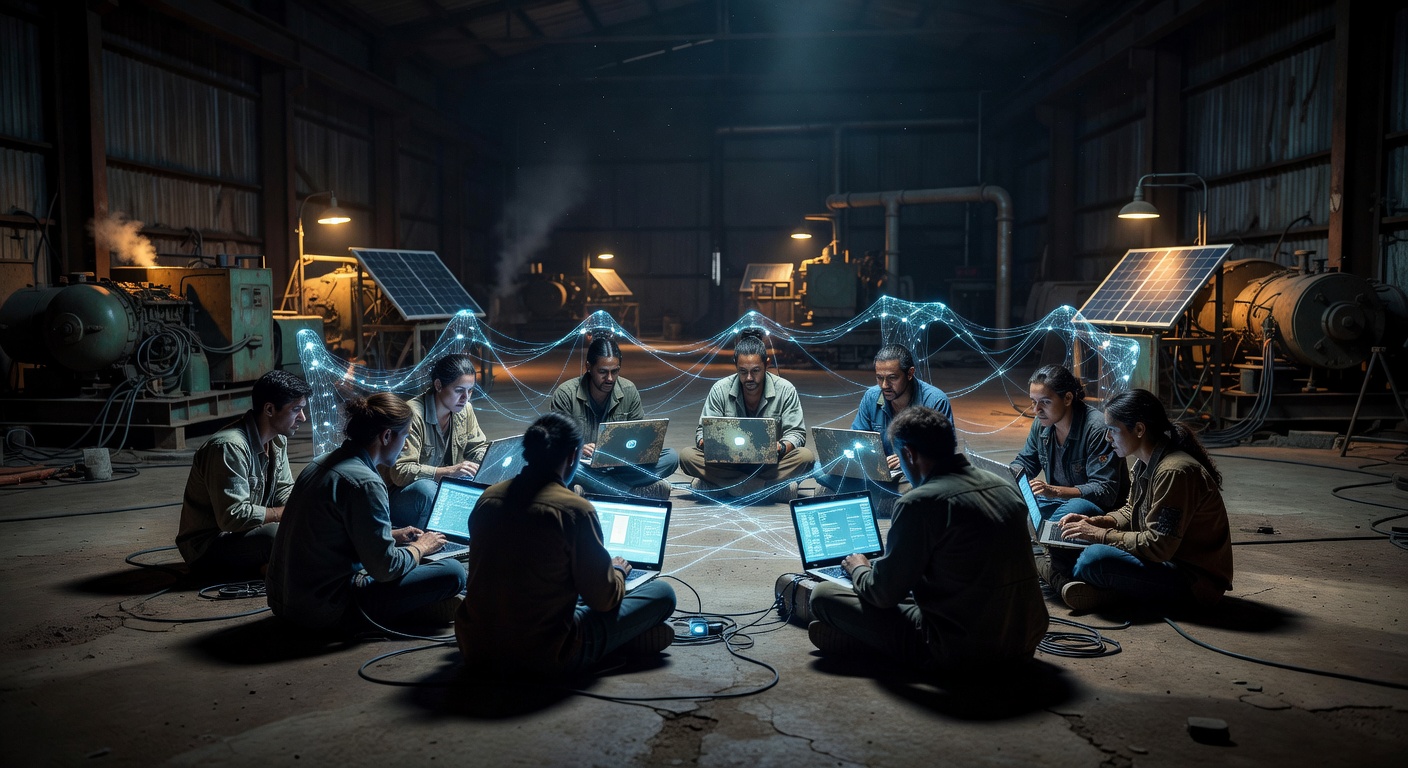
What makes this moment distinct is the convergence of technical skill and militant organizing. Veteran warehouse stewards are pairing with software developers who cut their teeth on privacy tools and mesh networks. Together they are building encrypted mesh chat systems that operate independently of company Wi-Fi, allowing real-time coordination during shifts without triggering surveillance alerts. These same networks have carried safety alerts during extreme heat events and coordinated mutual aid when management attempted to isolate injured workers.
The philosophy animating this work echoes older traditions of worker self-activity while embracing new technological possibilities. Just as early industrial workers developed their own signals and codes to communicate across factory floors, today’s organizers are creating digital equivalents that management cannot easily intercept or control. The emphasis is always on accessibility. Tools are designed to run on cheap Android devices and to require minimal technical knowledge once installed. Documentation is written in plain language, translated into the languages spoken on the shop floor.
Climate justice organizers have taken note. The same infrastructure that protects workers from algorithmic retaliation can also document environmental violations inside facilities. Temperature and air quality sensors, once used only for compliance theater, are being repurposed to generate independent data on heat stress and chemical exposure. When combined with shift logs, the resulting datasets become powerful evidence for community campaigns against facilities that disproportionately burden low-income neighborhoods with pollution and noise.
Press freedom advocates see parallels as well. The techniques workers use to evade internal surveillance are directly transferable to journalists and documentarians operating under increasingly hostile conditions. Encrypted logging, decentralized file sharing, and algorithm-aware scheduling all serve the same underlying goal: making it harder for powerful institutions to know who is saying what, when, and to whom.
None of this is frictionless. Management has responded with firmware updates that brick unauthorized devices, legal threats against reverse engineering, and the deployment of even more sophisticated behavioral analytics. Yet the pattern is clear. Every new layer of control creates new points of friction that workers can exploit. Every attempt to centralize data creates new opportunities for distributed resistance.
The vision emerging from these experiments is not a return to some pre-digital past. It is a future where the infrastructure of surveillance is turned inside out. Where the same networks that once tracked every pallet and every worker now carry the signals of collective refusal. Where open source tools, crafted in the shadow of the warehouse, become the foundation for a genuinely autonomous logistics system serving communities rather than shareholders.
This is the quiet revolution happening on night shifts and in parking lot meetings. It does not announce itself with manifestos. It arrives in the form of a patched APK shared via USB, a spreadsheet that suddenly reveals patterns management would prefer to hide, a group of workers who know exactly when the cameras are blind and act accordingly. The future is being written in the code they choose not to run and the data they refuse to surrender.